
Zone of Proximal Development: What It Is and Why It Changes How Teaching Works
A toddler can stack two blocks alone but builds a five-block tower the moment a parent steadies the base. A student stares blankly at a word problem, then solves it in under a minute once a teacher rephrases the question. Neither child got smarter in that instant. They were both already standing in what Lev Vygotsky called the zone of proximal development, the space between what a learner can do alone and what they can do with the right kind of help.
That gap is not a footnote in developmental psychology. It is one of the most practically useful ideas the field has ever produced, because it tells educators exactly where to aim instruction instead of guessing.
Key Takeaways
- The zone of proximal development is the gap between what a learner can do independently and what they can do with guidance from someone more skilled.
- Vygotsky argued learning drives development forward, not the other way around, putting him at odds with Piaget’s stage-based model.
- Zone of proximal development examples show up at every age, from toddlers stacking blocks to adults learning new software at work.
- Scaffolding and the more knowledgeable other are the mechanism and the guide; the zone itself is just the space where growth is possible.
- The concept has real limitations, including how hard it is to measure and how culturally specific its original assumptions were.
What Vygotsky Actually Meant by ZPD
Vygotsky introduced the idea in Mind in Society, published in 1978, though he developed the thinking in the early 1930s, shortly before his death in 1934 (Vygotsky, 1978). The original Russian phrase translates more precisely as the zone of nearest development, which is a useful correction. The zone is not some distant stretch goal. It is the very next layer of ability already within a learner’s reach.
Vygotsky defined it as the distance between what a learner can solve independently and what they can solve with guidance from an adult or a more capable peer (Vygotsky, 1978). That framing challenged the dominant thinking of his era. Most psychologists treated learning as something that had to wait for development to catch up. Vygotsky flipped it: learning pulls development forward, not the reverse.
He also built the concept as a direct critique of static intelligence testing. A single test score captures what a child has already mastered. It says nothing about what that child could do next with support, which Vygotsky considered the far more useful number for anyone actually trying to teach.
The Three Zones: Actual, Proximal, and Beyond Reach
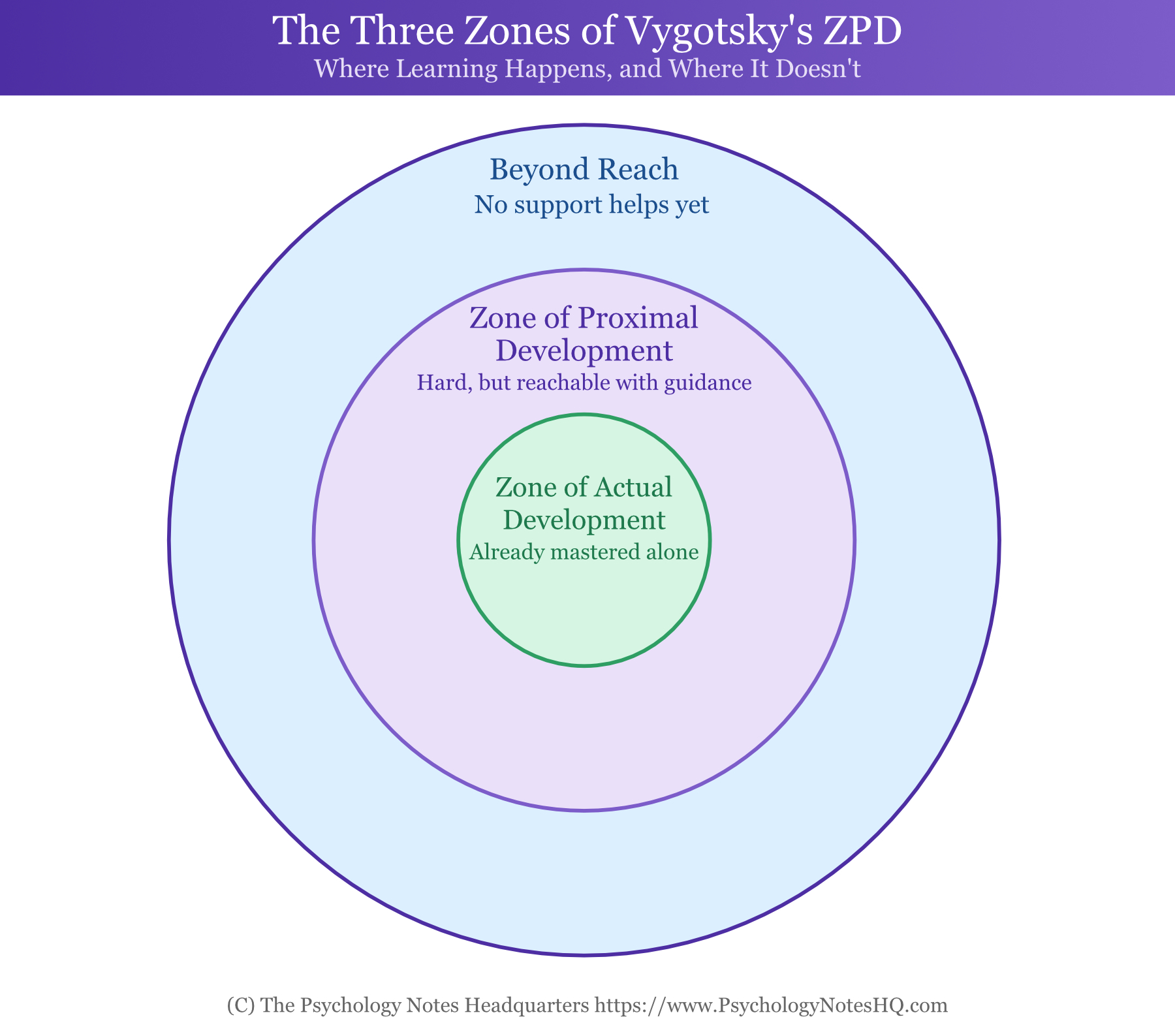
Picture three concentric rings. The innermost ring holds everything a learner has already internalized completely. No growth happens here because the skill is already locked in; this is the zone of actual development.
The middle ring is the zone of proximal development itself. Tasks here are hard but reachable with the right support. This is where instruction actually does something, and it keeps shifting as skills move from the middle ring into the center.
The outer ring holds tasks that stay out of reach no matter how much support gets applied, because the underlying groundwork hasn’t been built yet. Effective teaching lives almost entirely in that middle ring. Aim too low and students coast. Aim into the outer ring and even skilled instruction produces nothing. Knowing where a student’s zone actually sits matters more than any specific teaching technique.
Zone of Proximal Development Examples Across Age Groups
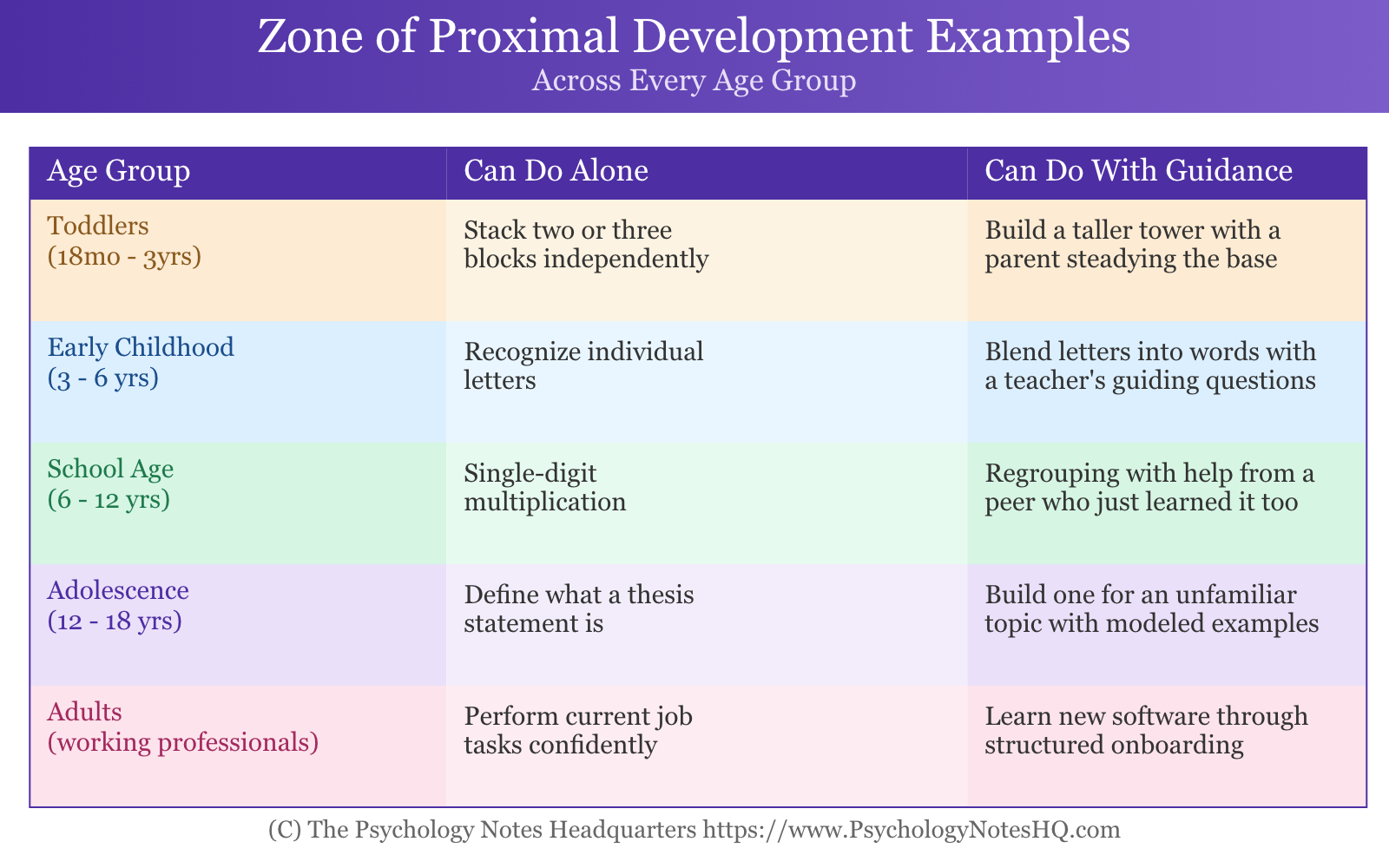
One reason this concept has held up for nearly a century is how cleanly it maps onto ordinary learning at every stage of life. These zone of proximal development examples make the abstract idea concrete.
A toddler around age two can usually stack a couple of blocks solo. With a parent steadying the base and narrating each move, that same toddler builds a taller tower than they could manage alone. The guided version is the zone of proximal development in action; the unassisted version is not yet there.
A kindergartener who knows individual letters may not yet blend them into words. A teacher who asks “what sound does the c make, what about the a” turns an inaccessible word into a readable one within seconds. That prompting sits squarely inside the zone.
An elementary student who has mastered single-digit multiplication often stalls the moment regrouping shows up. Interestingly, a classmate who figured out regrouping last week frequently explains it better than a teacher who mastered it decades ago, because their zones sit closer together.
A teenager drafting a first argumentative essay might understand what a thesis statement is in theory but can’t build one for an unfamiliar topic. Modeled examples and targeted feedback make the next step visible without doing the writing for them.
Adults are not exempt. A professional learning new software, picking up a second language, or shifting to a new curriculum still has a zone of proximal development for that skill. Structured onboarding and mentorship programs are, whether anyone labels them this way or not, built entirely on this principle.
ZPD vs Scaffolding vs the More Knowledgeable Other
These three terms get tangled together constantly, so it’s worth separating them cleanly.
The zone of proximal development is the space itself, the theoretical range where assisted learning becomes possible. Scaffolding is the mechanism that operates inside that space. It was not Vygotsky’s term at all; Wood, Bruner, and Ross introduced it in 1976 to describe how tutors support children through problem solving, building on Vygotsky’s framework without ever quoting his exact language.
The more knowledgeable other is the person supplying that scaffolding. Teachers are the obvious candidate, but the role is deliberately broad. An older sibling, a slightly more advanced classmate, a workplace mentor, or increasingly an adaptive piece of software can all function as the guide, as long as their input lands inside the learner’s actual zone rather than sailing over it.
That last part trips people up. A domain expert who explains at an expert level frequently overshoots the zone entirely. The most effective guide isn’t the one who knows the most. It’s the one whose explanation lands exactly one step ahead of where the learner currently stands.
ZPD in the Classroom: What It Looks Like in Practice
Translating the zone of proximal development into daily classroom decisions is where the concept earns its keep.
Dynamic assessment flips traditional testing on its head. Instead of measuring only what a student can do unaided, it tracks performance as hints and prompts get introduced gradually, and the point where minimal support produces a breakthrough marks the lower edge of the zone (Lantolf & Thorne, 2006). It is more resource-intensive than a standard test, but even a short structured interaction can reveal capability a static exam would miss entirely, particularly for second language learners.
Differentiated instruction is essentially an attempt to hit each student’s zone individually rather than aiming for the class average, which lands too easy for some students and impossibly hard for others.
Strategic peer tutoring works better when the tutor’s ability sits just slightly above the learner’s, not miles above it. Closer zones mean more accessible explanations.
Formative feedback that points toward a specific next step, rather than just marking an answer wrong, operates directly within the zone. So does guided questioning, which pushes students to reason through a problem instead of receiving the answer outright.
Getting any of this right depends on reading the zone accurately in the first place. Pitching support too high or too low are both common failure modes, and either one undercuts the whole approach.
None of these practices require expensive tools or major curriculum overhauls. Most of them come down to noticing where a student gets stuck, then adjusting the next question or prompt accordingly. Teachers who track this informally, even without formal dynamic assessment, tend to develop an intuitive read on each student’s zone over the course of a term. That intuition is itself a skill worth naming and building deliberately, since it shapes almost every instructional decision a teacher makes day to day.
ZPD vs Piaget: Two Views on How Learning Works
The contrast with Piaget is one of the more consequential disagreements in developmental psychology.
Piaget’s theory of cognitive development holds that cognitive structures mature in a fixed, biologically driven order. A child in the preoperational stage can’t yet perform logical operations, not for lack of teaching, but because the underlying structures haven’t developed yet. Development sets the ceiling; instruction can’t push a child past their current stage.
Vygotsky’s zone of proximal development proposes something close to the opposite. Learning doesn’t wait on maturation, it actively drives it. Guided social interaction can move development forward in ways that natural growth alone would not produce on its own timeline. Most contemporary developmental psychologists treat the two views as complementary rather than a straight either-or, and a closer side-by-side comparison of Vygotsky and Piaget lays out where exactly the two frameworks diverge.
Where ZPD Shows Up Beyond the Classroom
The concept travels well past academic subjects. A gymnast who can land a cartwheel but not yet a roundoff is working in their zone for that skill, and a coach spotting them through the rotation is doing precisely what Vygotsky described, just on a mat instead of at a desk.
Emotional development follows the same pattern. A young child who can stay calm during frustration when an adult models slow breathing and narrates each step is working within their zone for self-regulation, a co-regulated moment that gradually becomes independent.
The same logic underlies metacognitive skills, the ability to monitor and adjust one’s own thinking. Nobody arrives at those skills naturally. They develop through guided practice, often through a more experienced learner modeling their thinking out loud before gradually handing the strategy over.
Common Misconceptions About the Zone of Proximal Development
A few myths persist even in published teaching materials.
Harder tasks are not automatically inside the zone. A task only belongs there if it becomes achievable with the right guidance; tasks genuinely beyond a learner’s current reach stay out of reach no matter how much support gets thrown at them.
Scaffolding and the zone are not interchangeable terms. The zone is the space; scaffolding is one method of working inside it, and scaffolding aimed outside that space, whether too simple or too advanced, doesn’t produce the results the method promises.
The zone is not fixed. As skills move from the middle ring into the zone of actual development, new tasks enter the zone from the outer ring, which means zone-based assessment has to stay ongoing rather than a one-time snapshot.
It also isn’t exclusive to children. Adults switching careers, learning a language, or adjusting to an unfamiliar environment carry zones of proximal development for those exact challenges.
And not every peer interaction counts as zone-based learning. Watching and imitating a more skilled peer is a related but distinct process from true collaborative learning inside the zone, which requires guidance from someone operating just above the learner’s current level.
Criticisms and Limitations
The zone of proximal development carries real influence in education, but it has drawn serious academic criticism too.
Measuring it is genuinely difficult. Unlike Piagetian stages, which can be probed with specific tasks like conservation, the zone has no reliable psychometric tool. It shifts by subject, by day, and by learner, which makes it hard to track across a classroom of thirty students (Chaiklin, 2003).
The framework also carries cultural assumptions from the specific Soviet context Vygotsky worked within, particularly around verbally mediated, adult-guided interaction. Research in other cultural settings has found that peer learning and community-based knowledge transmission sometimes matter more than direct adult guidance, patterns the original framework doesn’t fully account for (Moll, 1990).
Some critics, drawing more from Piaget, argue that leaning too heavily on guided instruction can crowd out self-directed exploration and intrinsic motivation. And practically speaking, identifying each student’s zone across multiple subjects and then designing instruction around each one takes time and training that most classrooms don’t have room for.
None of this erases the core insight. It just means the zone of proximal development works best as one lens within Vygotsky’s broader sociocultural theory, not as a standalone formula for teaching.
Conclusion
The zone of proximal development reframes a simple question. Instead of asking what a learner can already do, it asks what they can do next and how to get them there. That shift changes how teachers plan lessons, how mentors coach, and how anyone in a guiding role thinks about the difference between support that builds real capability and support that just removes the challenge entirely.
References
- Chaiklin, S. (2003). The zone of proximal development in Vygotsky’s analysis of learning and instruction. In A. Kozulin, B. Gindis, V. S. Ageyev, & S. M. Miller (Eds.), Vygotsky’s educational theory in cultural context (pp. 39-64). Cambridge University Press.
- Lantolf, J. P., & Thorne, S. L. (2006). Sociocultural theory and the genesis of second language development. Oxford University Press.
- Moll, L. C. (Ed.). (1990). Vygotsky and education: Instructional implications and applications of sociohistorical psychology. Cambridge University Press.
- Vygotsky, L. S. (1978). Mind in society: The development of higher psychological processes. Harvard University Press.
- Wood, D., Bruner, J. S., & Ross, G. (1976). The role of tutoring in problem solving. Journal of Child Psychology and Psychiatry, 17(2), 89-100.
How to cite this article:
The Psychology Notes Headquarters. (2026). Zone of Proximal Development: What It Is and Why It Changes How Teaching Works. Retrieved from https://www.psychologynoteshq.com/zone-of-proximal-development/