
Scaffolding in Psychology Explained: 7 Techniques That Work
Picture a tutor sitting beside a student who is stuck halfway through a problem, offering just enough of a nudge to get them moving again without doing the work for them. That is scaffolding in psychology in practice: temporary, adjustable support that helps a learner complete a task they could not yet manage alone. The idea traces back to a 1976 study by Jerome Bruner, David Wood, and Gail Ross, who built on Lev Vygotsky’s Zone of Proximal Development to describe how skilled tutors calibrate their help. Three features separate real scaffolding from ordinary teaching help, and knowing where most classrooms get it wrong changes how the concept reads on paper.
Key Takeaways
- Scaffolding in psychology only works within a specific window of learner readiness, not across an entire task from start to finish.
- Three features separate scaffolding in psychology from generic teaching help: contingent support, gradual fading, and transfer of responsibility.
- Vygotsky scaffolding depends heavily on language, but the techniques that put it into practice go well beyond simply talking a learner through a task.
- Most scaffolding attempts fail for one of two opposite reasons, and the fix is rarely about adding more support or less of it.
- Seven techniques cover nearly every classroom scenario, from a kindergarten reading lesson to a college research paper.
What Is Scaffolding in Psychology? Core Definition and Origins
A kindergarten teacher working with a struggling reader will not simply read a word aloud or tell the child to sound it out. She covers part of the word with her finger, revealing only the first letter, then the next, guiding the blending process step by step. As the child gains confidence, she reduces this support, first revealing two letters at once, then letting the child try whole words independently.
This shows the scaffolding meaning in psychology in action: a teaching strategy that provides structured, temporary support to help learners accomplish tasks slightly beyond their current independent capabilities. The metaphor comes from construction scaffolding. Just as physical scaffolding supports workers building a structure and is removed once the building can stand alone, educational scaffolding supports learners developing new skills and is withdrawn once competence is achieved.
The term scaffolding emerged from a 1976 study by psychologists Jerome Bruner, David Wood, and Gail Ross, who observed how tutors helped young children solve problems. They noticed that effective tutors did not simply show children the answers or leave them to struggle independently. Instead, they provided strategic assistance calibrated to each child’s current level, offering more help when children struggled and stepping back when children showed competence. The study of scaffolding in psychology has since expanded well beyond early childhood research, with researchers now examining how scaffolding operates across age groups, disciplines, and cultural contexts.
Although Bruner and colleagues coined the term, the concept draws heavily from Soviet psychologist Lev Vygotsky’s earlier work on the Zone of Proximal Development. Scaffolding represents the practical application of Vygotsky’s theoretical framework, translating abstract developmental psychology into concrete teaching strategies that educators and parents can implement in everyday learning situations.

Vygotsky’s Scaffolding Theory: The Sociocultural Foundation
Vygotsky scaffolding starts with understanding Vygotsky’s revolutionary ideas about how learning and development occur. Unlike theorists who viewed learning as an individual, internal process, Vygotsky’s sociocultural theory positioned learning as fundamentally social, emerging first through interaction with others and only later becoming internalized. The principles underlying Vygotsky scaffolding, targeting the ZPD, adjusting support based on readiness, and fading as competence grows, have since been validated by decades of educational research.
Vygotsky’s Zone of Proximal Development
Vygotsky identified three distinct zones of learning capability for any given task. First, there is what a learner can do independently without any assistance, skills already mastered and internalized. Second, there is what a learner absolutely cannot do, even with extensive support, tasks too far beyond current development. Between these extremes lies the Zone of Proximal Development: tasks the learner cannot yet do independently but can accomplish with appropriate guidance from a more capable partner.
The ZPD represents the sweet spot for learning and development. Tasks within this zone are challenging enough to promote growth but not so difficult that they create overwhelming frustration. When instruction targets the ZPD, learners stretch their capabilities while experiencing success, building both competence and confidence. Scaffolding operates precisely within this zone, providing the support necessary to make challenging but achievable tasks accessible.
Vygotsky argued that instruction should precede development rather than following it. Unlike Piaget’s stages of cognitive development, which suggested children could only learn what their developmental stage allowed, Vygotsky believed that well designed instruction within the ZPD actually drives development forward. When compared side by side, Vygotsky and Piaget differ sharply on this point: for Vygotsky, good teaching leads development; for Piaget, development leads learning. The assistance provided today becomes tomorrow’s independent capability as learners internalize the supported skills.
Social Learning and More Knowledgeable Others
Central to Vygotsky’s theory is the idea that cognitive development emerges through social interaction. Children learn by participating in culturally meaningful activities alongside more capable partners who demonstrate, explain, and guide. These partners, whom Vygotsky called More Knowledgeable Others (MKO), can be teachers, parents, older siblings, or even capable peers.
The MKO serves as the provider of scaffolding, adjusting support based on the learner’s changing needs. This is not a one-way transmission of knowledge from expert to novice but rather a collaborative process where both participants actively engage in problem solving. The MKO watches carefully, assesses the learner’s current understanding, and provides just enough assistance to keep the learner moving forward without taking over completely.
Importantly, the MKO does not need to be an adult or formal teacher. In peer scaffolding situations, students slightly more advanced in a particular skill can effectively scaffold their classmates’ learning. This benefits both parties: the tutor deepens understanding through explanation while the learner receives support from someone who recently mastered the same material and may better understand the difficulties involved.
Language as a Tool for Learning
Vygotsky emphasized language as humanity’s most important psychological tool. Vygotsky’s work on thought and language development shows how children first regulate behavior through dialogue with others, then through private speech directed at themselves, and eventually through internalized thought. A toddler reminded to use gentle touch when petting the dog gradually begins saying it to themselves, and eventually does not need to say it at all.
Scaffolding leverages language’s regulatory power. When teachers think aloud while solving problems, ask guiding questions, or provide verbal prompts, they are using language to scaffold learning. As learners internalize these linguistic tools, they develop the capacity to self-scaffold, asking themselves the same types of questions, using similar problem solving strategies, and regulating their own learning processes.
The Three Essential Features of Scaffolding
While scaffolding can take many forms depending on the learner and task, certain core features distinguish true scaffolding from other forms of instructional support.
Contingent Support
Effective scaffolding is contingent, responsive to the learner’s current level of understanding and performance. This means continuously assessing what the learner knows and can do, then providing support calibrated to that specific point in their learning journey. When a learner demonstrates competence, the scaffolder reduces assistance. When the learner struggles, the scaffolder increases support.
Contingency requires careful observation and flexibility. A teacher planning a lesson might anticipate general scaffolding needs, but actual implementation demands real time adjustment based on how students respond. If a planned hint proves insufficient, the scaffolder must be ready to provide additional support, perhaps a more explicit prompt, a worked example, or temporary simplification of the task.
Non-contingent support, by contrast, provides the same level of assistance regardless of learner performance. Giving every student identical hints whether they need them or not, or maintaining high support even after students demonstrate mastery, fails the contingency requirement. True scaffolding constantly adapts to the learner’s evolving capabilities.
Gradual Fading
Fading means systematically reducing support as the learner gains competence and confidence. The ultimate goal of scaffolding is independence, learners who can successfully complete tasks without external assistance. Fading prevents dependency by ensuring learners do not become reliant on support that will not always be available.
In practice, fading might involve moving from demonstrating the entire task to demonstrating only the first step, then providing only verbal prompts, then simply monitoring while the learner works independently. Each reduction in support represents a vote of confidence in the learner’s growing capability and creates opportunities for autonomous problem solving.
Timing fading appropriately is crucial. Premature withdrawal of support sets learners up for frustration and failure. But maintaining support too long prevents learners from developing independence and can communicate lack of confidence in their abilities. Effective scaffolders monitor performance carefully, fading support when learners demonstrate consistent success, reduced need for prompts, and growing confidence.
Transfer of Responsibility
The endpoint of successful scaffolding is complete transfer of responsibility from the scaffolder to the learner. Initially, the more knowledgeable other manages the cognitive load, making decisions about strategies, monitoring progress, and identifying errors. Through scaffolding, these responsibilities gradually shift to the learner, who increasingly takes charge of planning, executing, and evaluating their own work.
This transfer is not just about performing the task. It is about developing metacognitive awareness and self-regulatory skills. Learners should internalize not just what to do but how to approach new challenges, how to monitor their own understanding, and how to adjust strategies when initial approaches fail. Through scaffolded interaction, children develop self-regulation skills that extend far beyond the specific task being learned.
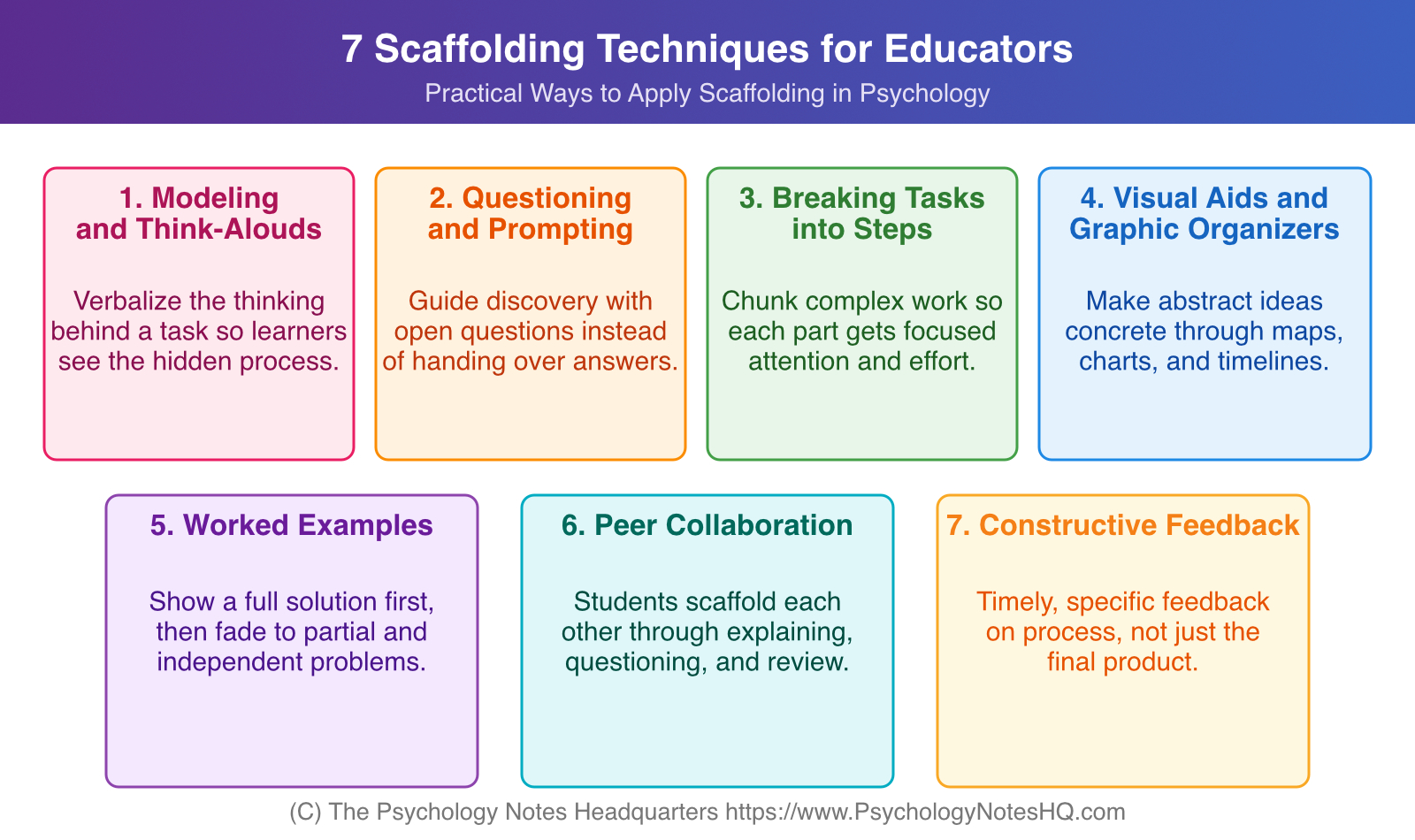
Seven Proven Scaffolding Techniques for Educators
Scaffolding can take countless forms, but certain techniques have proven particularly effective across different ages, subjects, and learning contexts.
Modeling and Think-Alouds
Modeling involves demonstrating how to perform a task while making your thinking visible through think-alouds, verbalizing the thought processes, decisions, and strategies you use. This technique is especially powerful because it reveals the often invisible cognitive work involved in skilled performance.
For example, a teacher modeling essay writing might say: I am starting by reading the prompt carefully. It asks me to argue a position, so I know I need to pick a side. Let me think about what I already know about this topic. I remember reading that, so I think I will argue that. Now I need to think about what evidence would support that claim.
This internal dialogue becomes external, allowing students to observe not just the final product but the messy, recursive process of expert thinking. Over time, students internalize these strategies, eventually using similar self-talk to guide their own work.
Questioning and Prompting
Strategic questioning guides learners toward discoveries rather than simply providing answers. Different types of questions serve different scaffolding purposes. Recall questions activate prior knowledge. Comprehension questions check understanding. Application questions promote transfer.
Open ended prompts encourage thinking without directing toward specific answers: tell me more about your reasoning, what patterns do you notice, how might you approach this differently. These prompts maintain learner agency while providing gentle guidance toward productive thinking.
Effective questioning requires patience, waiting for learners to formulate responses rather than rushing to fill silence. This wait time is itself a form of scaffolding, communicating confidence in the learner’s capacity to think through challenges independently.
Breaking Tasks into Smaller Steps
Complex tasks can overwhelm learners, making it difficult to know where to start. Breaking challenging activities into manageable components, sometimes called chunking or task analysis, makes the work feel approachable while ensuring each step receives adequate attention.
A teacher might break essay writing into distinct phases: brainstorming, creating an outline, writing an introduction, developing body paragraphs, crafting a conclusion, and revising. Initially, the teacher might guide students through each phase explicitly. Over time, as students internalize the process, they can manage the sequencing independently.
The key is ensuring that decomposition is temporary. The goal is not to always have students work on isolated components but to help them understand how pieces fit together so they can eventually manage the entire process holistically.
Using Visual Aids and Graphic Organizers
Visual scaffolds make abstract relationships concrete and organize information spatially. Concept maps show connections between ideas. Venn diagrams highlight similarities and differences. Flow charts illustrate sequences and decision points. Timelines organize events chronologically. These tools reduce cognitive load by externalizing organization, allowing learners to focus on content rather than structure.
During the preoperational stage, children particularly benefit from concrete visual scaffolding that makes abstract concepts tangible. But visual supports remain valuable throughout development, helping learners at all ages organize complex information effectively.
In practice, that means moving from completed graphic organizers to partially completed ones, then blank templates, then no template at all.
Providing Worked Examples
Worked examples show complete solutions to problems, allowing learners to study the process without the cognitive demands of solving. This technique is particularly effective in mathematics and sciences, where understanding solution strategies is as important as finding answers.
Fully worked examples come first, then partial examples with learners completing the remaining steps, then independent problems. Research shows that alternating between studying worked examples and solving practice problems promotes deeper learning than practice alone.
Collaborative Learning and Peer Scaffolding
Reciprocal teaching exemplifies structured peer scaffolding, the technique version of the More Knowledgeable Other role covered earlier. Students take turns leading discussion about texts, practicing skills like summarizing, questioning, clarifying, and predicting. Initially, the teacher models these strategies, but students gradually assume leadership roles, scaffolding each other’s comprehension. Observational learning complements scaffolding here, since much of what students pick up comes from watching a peer work through a problem.
Effective collaborative scaffolding requires careful group composition and clear role structures. The sweet spot pairs learners whose ZPDs overlap, where one student’s independent capability matches the other’s ZPD.
Timely, Constructive Feedback
Feedback serves as scaffolding when it provides specific, actionable information about current performance and paths toward improvement. Unlike simple correction, scaffolding feedback helps learners understand why errors occurred and how to avoid them: you applied the formula correctly, but remember that when the number is negative, we need to.
Effective feedback is timely, provided while learners still have the problem fresh in mind and can apply suggestions. It is specific rather than general, pointing to particular elements rather than making vague judgments. And it is focused on the process and strategies rather than just the product, helping learners develop transferable problem solving approaches.
Crucially, scaffolding feedback encourages a growth mindset by framing errors as learning opportunities rather than failures. Comments like I can see you are thinking about this carefully, let us consider another approach, maintain learner confidence while providing necessary correction.
Real-World Scaffolding Across Age Groups
Scaffolding looks different depending on the learner’s age, developmental stage, and the learning domain, but the core principles remain constant.
Early Childhood (Ages 2-5)
Young children receive scaffolding constantly from caregivers, though it often happens so naturally that adults may not recognize they are employing a sophisticated teaching strategy. Teaching a preschooler to use scissors involves hand over hand guidance initially, then holding the paper while the child cuts, then verbal reminders about thumb position, and finally watching as the child cuts independently.
Early literacy scaffolding follows the same pattern through shared reading: adults initially read everything, then pause for children to fill in predictable words, then alternate pages, eventually supporting as children read independently. This graduated approach lets children participate in reading before they have all the necessary skills.
Elementary School (Ages 6-11)
During the concrete operational stage, children can engage in logical reasoning but still need concrete, hands on support for new concepts. Mathematical problem solving benefits from scaffolding that makes thinking visible: first, let us identify what information we have, now, what is the question asking, what operation would make sense here. Over time, students internalize these problem solving steps, asking themselves the same questions the teacher originally posed.
Writing development often involves sentence frames for struggling writers and graphic organizers for planning, both gradually withdrawn as fluency and organizational skill develop.
Adolescence (Ages 12-18)
Abstract reasoning in science classes can be scaffolded through structured inquiry rather than open ended discovery: teachers provide guiding questions, suggest variables to manipulate, and help interpret results. Essay writing and argumentation follow a similar pattern, with paragraph templates and peer review standing in for the direct modeling used at younger ages.
Project based learning creates opportunities for multifaceted scaffolding. Teachers might scaffold time management with milestone deadlines, research skills with source evaluation criteria, and presentation skills with rubrics, each support fading on its own schedule as students take on more of the project independently.
Common Mistakes and How to Avoid Them
Despite scaffolding’s effectiveness, implementation challenges can undermine its benefits. Understanding common pitfalls helps educators scaffold more effectively.
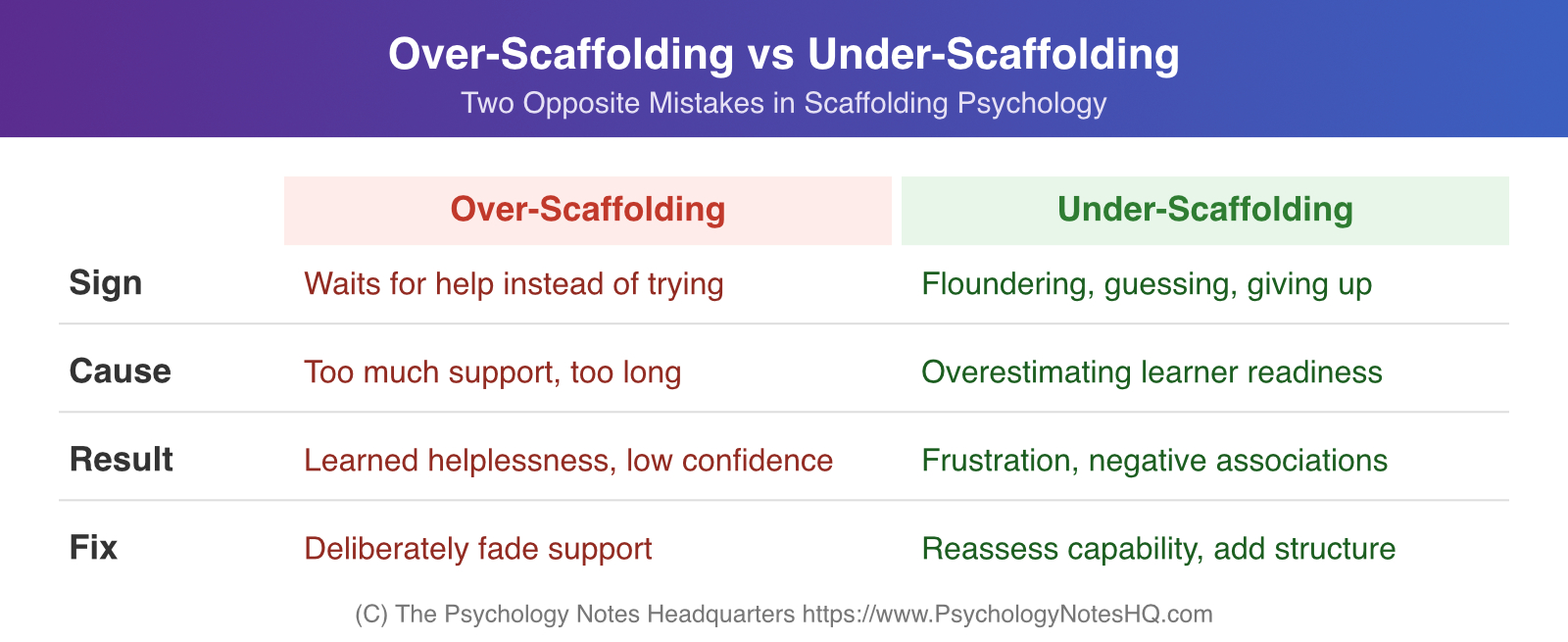
Over-Scaffolding and Learned Helplessness
Excessive scaffolding can lead to learned helplessness where students become dependent on support rather than developing autonomous problem solving skills. When teachers provide too much assistance, students learn to wait for help rather than attempting challenges independently. They may develop the belief that they cannot succeed without support, undermining confidence and self-efficacy.
Signs include students who consistently wait for teacher assistance, seem incapable of persisting through normal difficulty, or panic when asked to work independently. The fix is conscious, deliberate fading, paired with tolerance for the ordinary struggle that learning requires. Not every difficulty needs immediate intervention, only the kind that threatens to become disengagement.
Under-Scaffolding and Frustration
The opposite error, providing insufficient support, leaves learners floundering in tasks too far beyond their current capabilities. Without adequate scaffolding, learners may give up, develop negative associations with the subject, or practice errors that become difficult to correct later.
Under-scaffolding often stems from overestimating learner readiness or adhering to sink or swim philosophies that romanticize struggle. While productive challenge promotes learning, overwhelming challenge creates stress that actually impairs learning. The ZPD framework helps avoid this error: tasks should challenge learners while remaining within reach with appropriate support.
Indicators of under-scaffolding include high rates of task abandonment, visible frustration or anxiety, random guessing rather than strategic problem solving, and repeated errors without improvement. The solution involves assessing current capability more carefully, providing more structure initially, and ensuring tasks genuinely match the ZPD rather than exceeding it.
Failing to Fade Support
Perhaps the most common scaffolding error is maintaining support long after learners demonstrate readiness for independence. This happens for various reasons: teachers enjoy helping, worry about learner failure, lack confidence in learner capability, or simply forget to adjust support levels as competence develops.
Permanent scaffolding contradicts the entire concept. The point is not to make tasks achievable with support forever but to build toward independent capability. When scaffolds remain in place unnecessarily, learners never develop the confidence and skills that come from autonomous success.
Preventing this error requires intentional planning for fading. When introducing a scaffold, consider from the outset how and when it will be removed. Set benchmarks for reducing support, after three successful performances, after demonstrating specific skills, or within particular timeframes. Regularly assess whether current support levels remain necessary or have become habit.
One-Size-Fits-All Scaffolding
Learners differ in prior knowledge, learning preferences, cultural backgrounds, language proficiencies, and many other dimensions relevant to how they learn. Scaffolding that works perfectly for one student may be insufficient for another or excessive for a third. Effective scaffolding requires individualization based on careful assessment of each learner’s needs.
This does not mean creating completely different approaches for every student, which would be impractical in most educational settings. Instead, it involves developing a repertoire of scaffolding techniques and flexibly applying them based on ongoing assessment. Some students might need more concrete examples while others grasp abstract explanations easily.
Cultural responsiveness matters in scaffolding too. Different cultures have different norms around appropriate teacher-student interactions, comfortable learning activities, and valued knowledge forms. Scaffolding that feels supportive in one cultural context might feel intrusive or inappropriate in another. Effective scaffolders learn about and respect cultural variations in learning preferences.
Scaffolding vs. Other Teaching Approaches
Understanding how scaffolding relates to other instructional methods clarifies its unique characteristics and appropriate applications.
Scaffolding vs. Direct Instruction
Direct instruction involves teachers explaining concepts and demonstrating procedures while students listen and watch, then practicing similar problems independently. While this approach can be efficient for teaching straightforward procedural knowledge, it positions learners as passive recipients of information.
From a Vygotsky scaffolding standpoint, the key distinction is who carries the cognitive load. Direct instruction puts it on the teacher; scaffolding keeps it with the learner, with just enough support to prevent a stall.
The approaches are not mutually exclusive. Direct instruction might introduce a new concept, followed by scaffolding as students begin applying it. Understanding when each approach is most effective allows educators to use both strategically.
Scaffolding vs. Pure Discovery Learning
Pure discovery learning asks learners to figure things out independently with minimal guidance, based on the idea that self-discovered knowledge is deeper and more meaningful. While discovery can promote engagement and deep thinking, completely unguided discovery often proves inefficient and frustrating, particularly for novice learners lacking foundational knowledge.
Scaffolding represents a middle ground: guided discovery that provides structure and support while maintaining learner agency and problem solving engagement. Learners still do meaningful cognitive work and experience the satisfaction of figuring things out, but strategic scaffolding prevents excessive frustration and ensures productive rather than aimless exploration.
Research consistently shows that guided instruction, including scaffolding, produces better learning outcomes than pure discovery for most learners and most content. The key is balancing support with autonomy, providing enough structure to prevent floundering while leaving enough challenge to promote active thinking.
Assessing When and How Much to Scaffold
Knowing the learner’s current capability, not just their grade level, is what makes responsive scaffolding possible. This is where the tie between zone of proximal development and scaffolding becomes practical rather than theoretical: scaffolding is simply the moment to moment mechanism that operates inside the ZPD, and reading it well depends on cues beyond correct or incorrect answers.
Non-verbal cues carry much of that information. Body language, facial expressions, and work behaviors all signal learner states. A student staring blankly at a page needs different support than one writing furiously. One who keeps checking the clock may need motivational scaffolding. One who keeps glancing at peers may benefit from collaborative work.
Reading these cues requires attention and experience. Novice teachers sometimes miss subtle signals or misinterpret them. Developing assessment sensitivity is itself a skill that improves with practice and reflection.
Conclusion
Scaffolding in psychology represents teaching at its best: meeting learners where they are and guiding them toward independence. Rooted in Vygotsky’s insight that development emerges through guided social interaction within the ZPD, scaffolding turns theory into practical strategies that build real competence and confidence. Understanding developmental tasks helps educators match support to developmental readiness while continuing to challenge learners toward growth. Whether helping a preschooler hold scissors or guiding a college student through a research paper, the core principle stays the same: temporary, fading support that transfers responsibility to the learner is at the heart of effective education.
References
- Berk, L. E., & Winsler, A. (1995). Scaffolding children’s learning: Vygotsky and early childhood education. National Association for the Education of Young Children.
- Daniels, H. (2016). Vygotsky and pedagogy. Routledge.
- Hammond, J., & Gibbons, P. (2005). Putting scaffolding to work: The contribution of scaffolding in articulating ESL education. Prospect, 20(1), 6-30.
- Pea, R. D. (2004). The social and technological dimensions of scaffolding and related theoretical concepts for learning, education, and human activity. Journal of the Learning Sciences, 13(3), 423-451.
- Smit, J., van Eerde, H. A., & Bakker, A. (2013). A conceptualisation of whole-class scaffolding. British Educational Research Journal, 39(5), 817-834.
- Vygotsky, L. S. (1978). Mind in society: The development of higher psychological processes. Harvard University Press.
- Wood, D., Bruner, J. S., & Ross, G. (1976). The role of tutoring in problem solving. Journal of Child Psychology and Psychiatry, 17(2), 89-100.
How to cite this article:
The Psychology Notes Headquarters. (2026). Scaffolding in Psychology Explained: 7 Techniques That Work. Retrieved from https://www.psychologynoteshq.com/scaffolding/