
Id, Ego and Superego: Who Wins When All Three Disagree?
The id, ego and superego are the three parts of the mind in Freud’s theory of personality: the id wants pleasure now, the superego demands you do the right thing, and the ego tries to satisfy both without wrecking your real life. Freud saw them as forces in constant negotiation, not places in the brain. Ever skipped a party to study, then felt guilty for wanting to go at all? That’s all three at work in one evening.
Key Takeaways
- Freud never used the words id, ego or superego. Find out what he actually called them and why some scholars say the English versions changed his meaning.
- The famous iceberg diagram isn’t Freud’s, and mixing it up with his three-part model is one of the most common exam mistakes.
- The ego isn’t the “selfish” part. In Freud’s model it’s an overworked negotiator serving three demanding masters at once.
- A superego that’s too strong can cause as many problems as an id that runs wild.
- Modern psychology has kept some of Freud’s ideas and dropped others, including one famous “ego” finding that failed to replicate.
What Is Freud’s Structural Model?
Freud’s structural model splits personality into three agencies that push and pull against each other. Freud set it out in The Ego and the Id (Freud, 1923/1961), more than two decades after his first map of the mind.
The key word is agencies. The id, ego and superego are not lumps of tissue you could find on a brain scan. They describe three kinds of mental demand: what you crave, what you believe you should do, and what reality will actually let you get away with.
Lost in Translation: The It, the I and the Over-I
Here’s a fact that surprises most students: Freud never wrote “id,” “ego” or “superego.” He wrote in everyday German: das Es (the It), das Ich (the I) and das Über-Ich (the Over-I).
The Latin terms came from his English translators, led by James Strachey. Bruno Bettelheim (1983) argued that the swap made Freud sound colder and more clinical than he intended. “The I” feels personal. “The ego” sounds like something under a microscope.
The Id: The Part That Wants It Now
The id is the oldest part of the personality. It’s present from birth, it’s entirely unconscious, and it runs on the pleasure principle: seek pleasure, avoid pain, and do it immediately.
The id doesn’t do logic, time or consequences. A hungry baby screaming until fed is close to pure id. So is the part of you that wants a third slice of pizza at midnight.
Freud saw the id as the energy source for the whole system. The other two parts don’t have their own fuel. They borrow it.
The Ego: The Negotiator
The ego grows out of the id as a baby starts bumping into reality. It runs on the reality principle: you can probably have what you want, just not right now and not like that.
Freud (1923/1961) compared the ego to a rider on a horse. The rider steers, but the horse supplies the power, and sometimes the rider ends up going where the horse wanted to go anyway.
This has nothing to do with the everyday meaning of ego as arrogance. In Freud’s model, a strong ego signals good judgment, not a big head.
The Superego: The Inner Judge
The superego is the last part to form, usually around ages 3 to 6. Freud believed it emerges as children take their parents’ rules inside themselves, a process he tied to the Oedipus complex.
It has two sides. The conscience punishes you with guilt when you break the rules. The ego ideal holds up a picture of the person you feel you should become.
Freud linked this inner judge closely to moral reasoning, and the way the conscience and ego ideal take shape during early childhood is a story of its own.
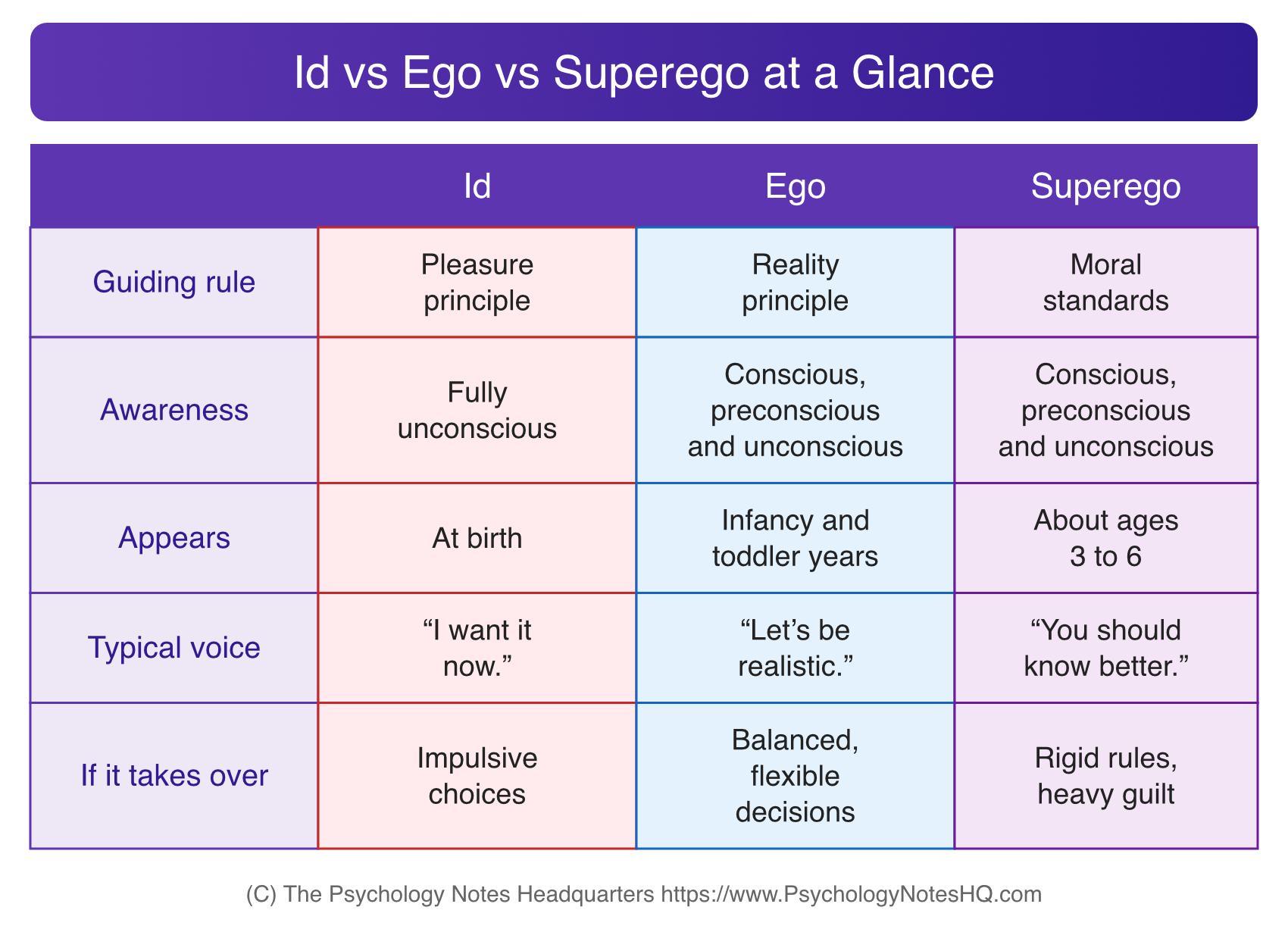
Pleasure Principle vs Reality Principle
These two principles explain most of the tension between the id and the ego.
| Pleasure principle | Reality principle | |
|---|---|---|
| Belongs to | Id | Ego |
| Goal | Immediate satisfaction | Satisfaction that actually works out |
| Timing | Now | When it’s safe or sensible |
| Typical thought | “I want it.” | “Not yet, but here’s how.” |
The reality principle doesn’t cancel the pleasure principle. It delays and redirects it.
You use the reality principle every time you wait for a better payoff: saving money instead of spending it, or finishing an assignment before opening a game. The want doesn’t disappear. It just gets scheduled.
How the Id, Ego and Superego Work Together
Freud described the ego as a servant with three harsh masters: the id, the superego and the outside world (Freud, 1933/1964). Each one makes demands, and they rarely agree.
The id pushes for pleasure. The superego pushes for perfection. Reality pushes back with deadlines, rules and other people. The ego’s job is to find a move that keeps all three quiet enough for you to function.
When it manages that, you barely notice. When it fails, you feel it as anxiety.
Id, Ego and Superego Examples From Student Life
The easiest way to understand the model is to watch all three parts argue over a single decision.
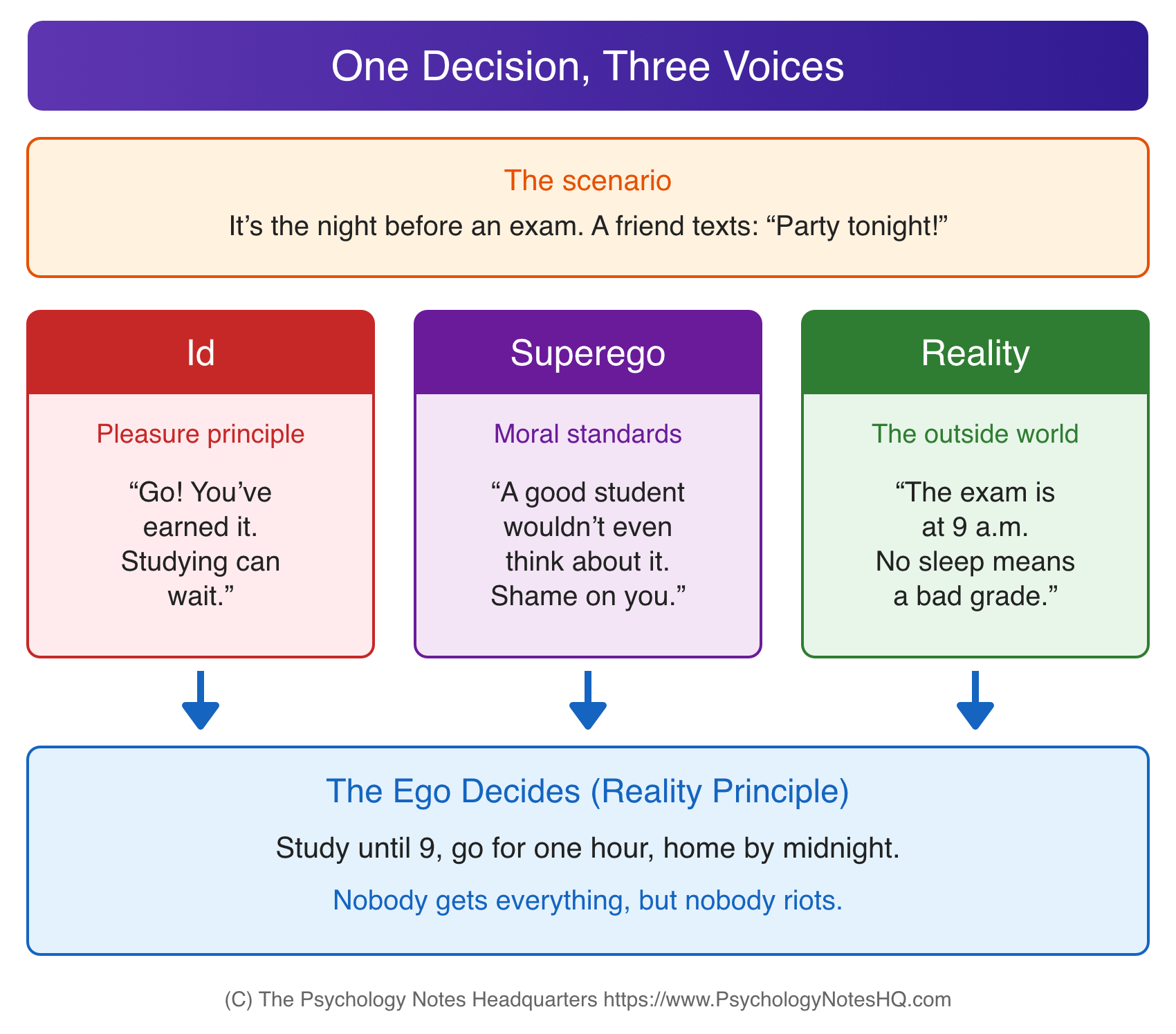
The Night Before the Exam
A friend texts: party tonight, everyone’s going. Your id says go, you’ve earned it. Your superego says a serious student wouldn’t even consider it, and makes you feel guilty for being tempted.
Your ego looks for a deal: study until 9, go for an hour, be in bed by midnight. Nobody gets everything, but nobody riots.
The Wallet on the Bus
You find a wallet with $80 inside. The id spots free money. The superego insists that returning every cent is the only acceptable option.
The ego weighs reality too. There’s a student ID inside, the owner is easy to trace, and getting caught keeping it would cost far more than $80. You hand it to the driver.
The Answer Key in the Group Chat
Someone posts the answers to tomorrow’s quiz. The id wants the easy A. The superego is horrified.
The ego asks the practical questions. What happens if this gets flagged for academic dishonesty? Will I actually know this material on the final? It mutes the chat. Notice that the ego isn’t being moral here. It’s being realistic.
The Text You Shouldn’t Send
It’s 1 a.m. and you’re about to message your ex. The id wants connection right now. The superego scolds you for being weak.
A healthy ego doesn’t simply side with the superego. It might suggest texting a close friend instead, which meets the need for connection without the morning-after regret.
The Group Project Teammate Who Vanished
One member of your group hasn’t answered messages in a week. The id wants to fire off an angry message to the whole chat. The superego says you should quietly do their share, because complaining is petty.
The ego finds a middle path: a calm message to the teammate, then a short note to the instructor if nothing changes.
When One Part Takes Over
Freud believed healthy functioning depends on balance, with a strong ego in charge. Problems start when one part dominates.
An id-dominated person acts on impulse and struggles with consequences. A superego-dominated person is the opposite: rigid, perfectionistic and weighed down by guilt over small mistakes. A weak ego gets pushed around by both and leans heavily on defenses to cope.
These are Freud’s descriptions, not modern diagnoses, but they’re a useful way to think about self-control and guilt.
What Ego Strength Looks Like
Later psychoanalytic writers used the term ego strength for the ego’s ability to handle pressure from all sides without falling apart.
Someone with strong ego strength can feel a powerful urge, notice the guilt that comes with it, and still make a reasonable choice. They tolerate frustration, bounce back from setbacks and don’t need extreme defenses to get through a bad week.
Weak ego strength looks like being ruled by whichever voice is loudest in the moment.
Anxiety: The Ego’s Alarm System
Freud linked each of the ego’s three masters to a different type of anxiety (Freud, 1933/1964):
- Realistic anxiety: fear of real danger in the outside world, like failing a course.
- Neurotic anxiety: fear that the id’s impulses will break through and cause trouble.
- Moral anxiety: fear of the superego’s punishment, felt as guilt or shame.
Anxiety works like a smoke alarm. It tells the ego something needs handling before things get worse.
Ego Defense Mechanisms in Brief
When anxiety gets too strong, the ego can protect itself without your awareness. Anna Freud (1936/1937) later expanded her father’s account of these ego defense mechanisms. Four that come up often in intro courses:
- Repression: pushing a threatening thought out of awareness.
- Projection: seeing your own unwanted feelings in someone else.
- Rationalization: inventing a good-sounding reason for what you did.
- Displacement: redirecting anger onto a safer target.
Rationalization overlaps with what social psychologists study as cognitive dissonance.
When Do the Id, Ego and Superego Develop?
| Part | When it appears | What triggers it |
|---|---|---|
| Id | Birth | Present from the start |
| Ego | Infancy and toddler years | Contact with the limits of reality |
| Superego | About ages 3 to 6 | Taking in parents’ rules and values |
This timeline lines up with Freud’s psychosexual stages. The id runs the show during the oral stage, while the ego and superego keep growing stronger through the quieter latency years.
Structural Model vs Topographical Model
Many exam errors start here, because Freud actually drew two different maps of the mind.
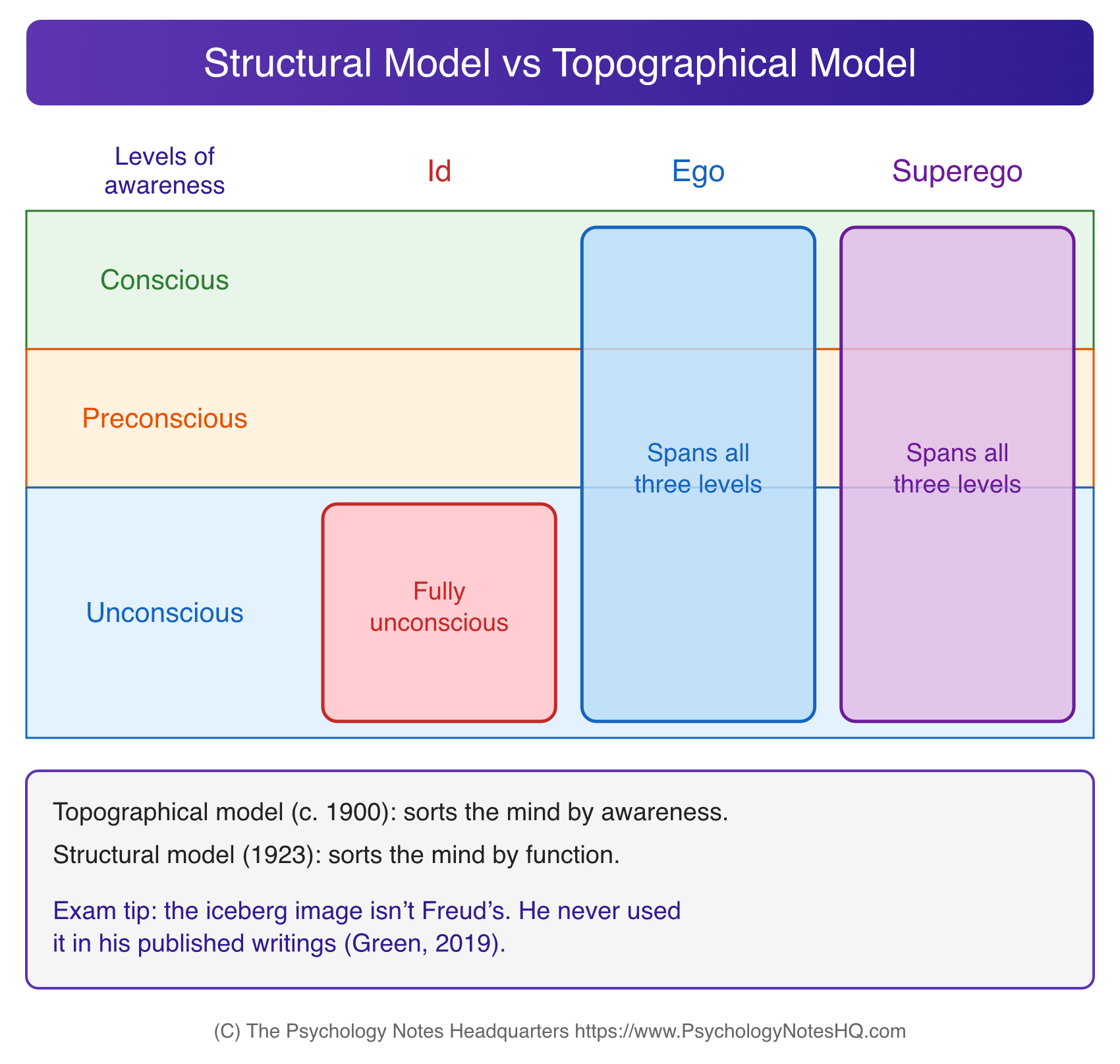
The topographical model, from his early work around 1900, sorts mental life by awareness: conscious, preconscious and unconscious. The structural model, from 1923, sorts it by function: id, ego and superego.
They aren’t the same map drawn twice. The id is fully unconscious, but the ego and superego stretch across all three levels. Much of what your ego does, including its defenses, happens without you noticing.
The Iceberg Problem
Nearly every intro textbook shows Freud’s mind as an iceberg. The awkward part: Freud never mentioned an iceberg in his published writings. Historian Christopher Green (2019) traced an early version of the metaphor to American psychologist G. Stanley Hall.
The bigger issue is what the iceberg blurs. Many versions stack the three parts in neat layers under the waterline, mixing both models into one picture. If an exam asks about Freud’s structural model, describe the three agencies and how they interact, not three levels of awareness.
Is Freud’s Model Still Used Today?
The biggest criticism is that the model is hard to test. You can’t measure an id, and almost any behavior can be explained after the fact as one part winning. A theory that can’t be proven wrong is a serious problem in science.
Still, Westen (1998) argued that some broad Freudian ideas hold up, including unconscious mental processes and the role of conflict in behavior. Freud’s influence also runs through later stage theories, which becomes obvious when you compare Freud and Erikson.
Where You’ll Still See the Model
Westen (1998) noted that even psychodynamic therapists no longer write much about ids and egos. The three-part model has moved from the clinic into the classroom and into everyday language.
You’ll still meet it in intro psychology exams, in literature and film analysis, and in phrases like “ego trip” or “my conscience won’t let me.” Knowing what Freud actually meant helps you spot when those everyday uses drift far from the original theory.
The “Ego” Finding That Didn’t Replicate
In 1998, Roy Baumeister and colleagues proposed ego depletion: the idea that self-control draws on a limited resource that runs down with use. Their paper credited Freud with anticipating the idea that the ego needs energy to do its work (Baumeister et al., 1998).
Dozens of studies followed. Then a 23-lab replication with more than 2,000 participants found an effect close to zero (Hagger et al., 2016). The original authors questioned the replication’s method, but ego depletion is now a well-known case in psychology’s replication crisis.
Exam Traps to Avoid
These five mix-ups cost students marks again and again:
- Treating the iceberg as the three-part model. Levels of awareness and parts of personality are two different maps.
- Calling the ego selfish. In Freud’s model, the ego is the sensible negotiator.
- Reducing the superego to morality. It also holds the ego ideal, your picture of who you should be.
- Treating the three parts as brain regions. They’re theoretical ideas, not anatomy.
- Assuming the superego is always right. Freud saw an overly harsh superego as a source of problems, not a sign of virtue.
Conclusion
Freud’s three-part model is less about labels and more about conflict. You want things, you judge yourself for wanting them, and somewhere in the middle you make a decision.
Whether or not you accept Freud’s theory, that tug of war is a useful lens for exam questions and for understanding your own 1 a.m. choices.
References
- Baumeister, R. F., Bratslavsky, E., Muraven, M., & Tice, D. M. (1998). Ego depletion: Is the active self a limited resource? Journal of Personality and Social Psychology, 74(5), 1252-1265.
- Bettelheim, B. (1983). Freud and man’s soul. Knopf.
- Freud, A. (1937). The ego and the mechanisms of defence (C. Baines, Trans.). Hogarth Press. (Original work published 1936)
- Freud, S. (1961). The ego and the id. In J. Strachey (Ed. & Trans.), The standard edition of the complete psychological works of Sigmund Freud (Vol. 19, pp. 1-66). Hogarth Press. (Original work published 1923)
- Freud, S. (1964). New introductory lectures on psycho-analysis. In J. Strachey (Ed. & Trans.), The standard edition of the complete psychological works of Sigmund Freud (Vol. 22, pp. 1-182). Hogarth Press. (Original work published 1933)
- Green, C. D. (2019). Where did Freud’s iceberg metaphor of mind come from? History of Psychology, 22(4), 369-372.
- Hagger, M. S., Chatzisarantis, N. L. D., Alberts, H., Anggono, C. O., Batailler, C., Birt, A. R., … Zwienenberg, M. (2016). A multilab preregistered replication of the ego-depletion effect. Perspectives on Psychological Science, 11(4), 546-573.
- Westen, D. (1998). The scientific legacy of Sigmund Freud: Toward a psychodynamically informed psychological science. Psychological Bulletin, 124(3), 333-371.
How to cite this article:
The Psychology Notes Headquarters. (2026). Id, Ego and Superego: Who Wins When All Three Disagree?. Retrieved from https://www.psychologynoteshq.com/id-ego-superego/