
Konrad Lorenz Imprinting: Why Goslings Followed a Scientist
In the 1930s, a line of newly hatched greylag geese waddled after an Austrian zoologist as if he were their mother. They weren’t confused. Konrad Lorenz’s imprinting research showed that some young birds form a lasting bond with the first moving object they encounter, during a short window soon after hatching.
Lorenz believed that window shut for good and the bond could never be undone. Later experiments with ducklings, chicks and kittens told a messier story. That story still shapes how psychologists think about timing in human development.
Key Takeaways
- Lorenz showed that goslings bond with the first moving object they see, even when that object is a human wearing boots and carrying a notebook.
- Lab work in the 1950s pinned the strongest imprinting to a surprisingly narrow window of hours after hatching.
- Later studies chipped away at Lorenz’s claim that imprinting is permanent, and one of them involved yellow rubber gloves.
- The shift from “critical” to “sensitive” periods changed how psychologists explain attachment, language and vision.
- Knowing where Lorenz was right and where he went too far is exactly what exam evaluation questions test.
Who Was Konrad Lorenz?
Konrad Lorenz (1903 to 1989) was an Austrian zoologist and one of the founders of ethology, the study of animal behavior in natural settings. He raised geese, ducks and jackdaws at close range and watched their behavior unfold day by day.
His 1935 paper on the “companion” in a bird’s world introduced the term imprinting (Prägung in German) and laid out much of the framework ethology would build on (Lorenz, 1935). In 1973, he shared the Nobel Prize in Physiology or Medicine with Niko Tinbergen and Karl von Frisch for their work on animal behavior.
Konrad Lorenz’s Imprinting Experiment
How the Gosling Study Worked
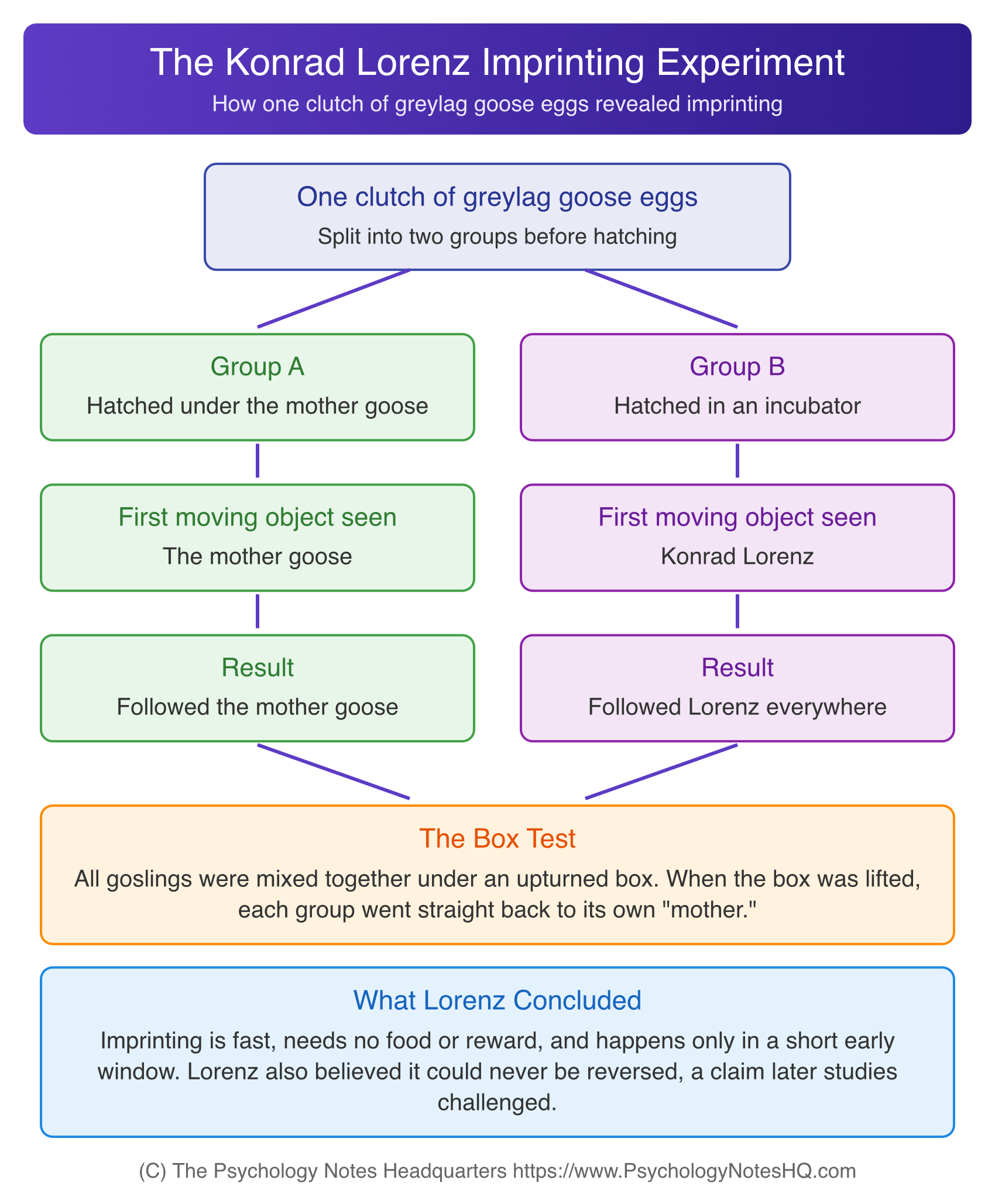
The classic version of Konrad Lorenz’s imprinting experiment is simple. Lorenz took a clutch of greylag goose eggs and split it in two. One half hatched under their mother. The other half hatched in an incubator, and Lorenz made sure he was the first moving thing those goslings saw.
The incubator goslings followed him everywhere. To test the bond, he put all the goslings together under an upturned box. When the box was lifted, the two groups sorted themselves out. One group went to the mother goose, and the other went straight to Lorenz.
What Lorenz Concluded
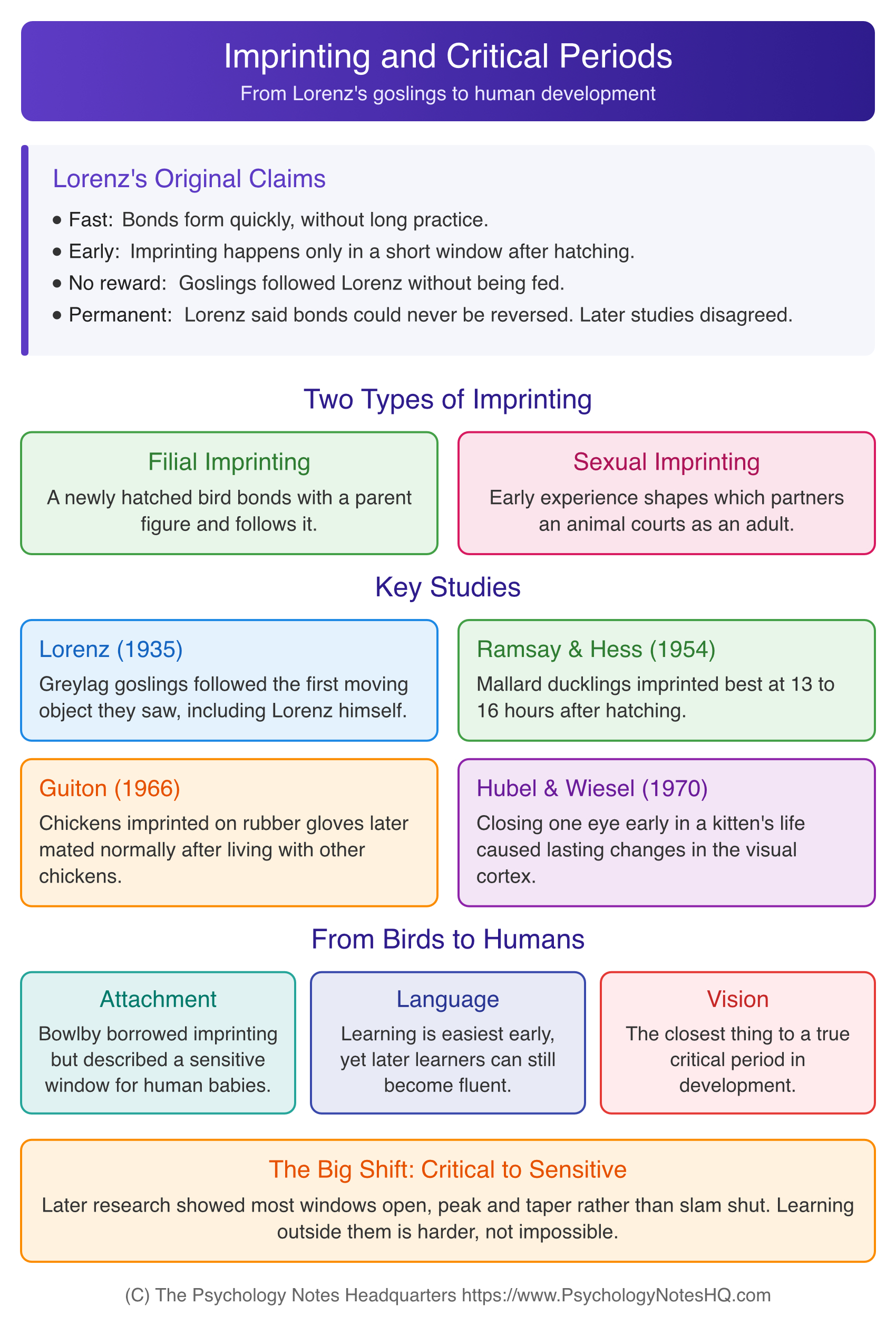
From observations like these, Lorenz drew four bold conclusions about imprinting:
- It happens quickly, without long practice or training.
- It happens only during a short window early in life.
- It doesn’t depend on food or any other reward.
- Once formed, it can’t be reversed.
The first three held up well. The fourth is where the story gets interesting.
What Makes an Object Worth Following?
Lorenz argued that young birds respond to “social releasers,” features of appearance or behavior that trigger an inborn response (Robledo et al., 2022). For a hatchling, movement is the big one. A moving object gets followed.
Sound helps too. Ramsay and Hess (1954) used a decoy that moved along a track while playing a call.
Birds aren’t blank slates either. Visually naive chicks already approach some colors and shapes more readily than others, so imprinting builds on built-in preferences rather than starting from zero (McCabe, 2019).
Filial Imprinting vs Sexual Imprinting
Lorenz saw imprinting as the way some birds learn what their own species looks like, which later guides who they follow and who they court (Robledo et al., 2022). Researchers now separate it into two types.
Filial Imprinting
Filial imprinting is the bond between a newly hatched bird and its parent figure. The young bird follows a conspicuous object, learns its features, and narrows its social preferences toward it (McCabe, 2019).
This is the following behavior Lorenz’s goslings showed. It’s strongest in precocial species such as ducks, geese and chickens, whose young can walk and leave the nest soon after hatching.
Sexual Imprinting
Sexual imprinting shapes later mate preferences. It usually shows up around the time an animal reaches its adult appearance, although experience in infancy can feed into it (McCabe, 2019).
Lorenz noticed that some hand-reared birds directed courtship at humans once they grew up. Observations like that turned early experience into a major topic in the study of mating behavior.
Why Imprinting Psychology Changed the Nature vs Nurture Debate
In the 1950s, imprinting psychology landed in the middle of the heredity vs learning debate. Imprinting clearly involved learning, since a gosling has to learn which object is “mother.” But it didn’t behave like ordinary learning.
Learning theorists of the time assumed babies bond with whoever feeds them, the way a dog in classical conditioning experiments learns to salivate at a bell. Lorenz’s goslings never needed food to follow him.
Imprinting also looked pre-wired, much like the inborn tendencies described in instinct theory. It sat awkwardly between nature and nurture, which is exactly why psychologists paid attention.
Why Did Imprinting Evolve?
For a precocial bird, the first days are dangerous. Ducklings and goslings leave the nest within hours or days, so a chick that stays close to a parent is far more likely to survive predators and cold.
Hardwiring a picture of “mother” into the brain wouldn’t work well, because parents differ in looks and sound. Imprinting solves this by combining a built-in urge to follow with fast learning about the specific adult nearby.
The same logic explains the timing. The window is open when the parent is almost certainly the closest moving object around.
Hess and the 13 to 16 Hour Window
Lorenz worked mostly through observation. Eckhard Hess and A. Ogden Ramsay brought imprinting into the lab. They released mallard ducklings into a runway where a papier-mâché decoy moved and called, then tested how well each duckling had learned to follow it.
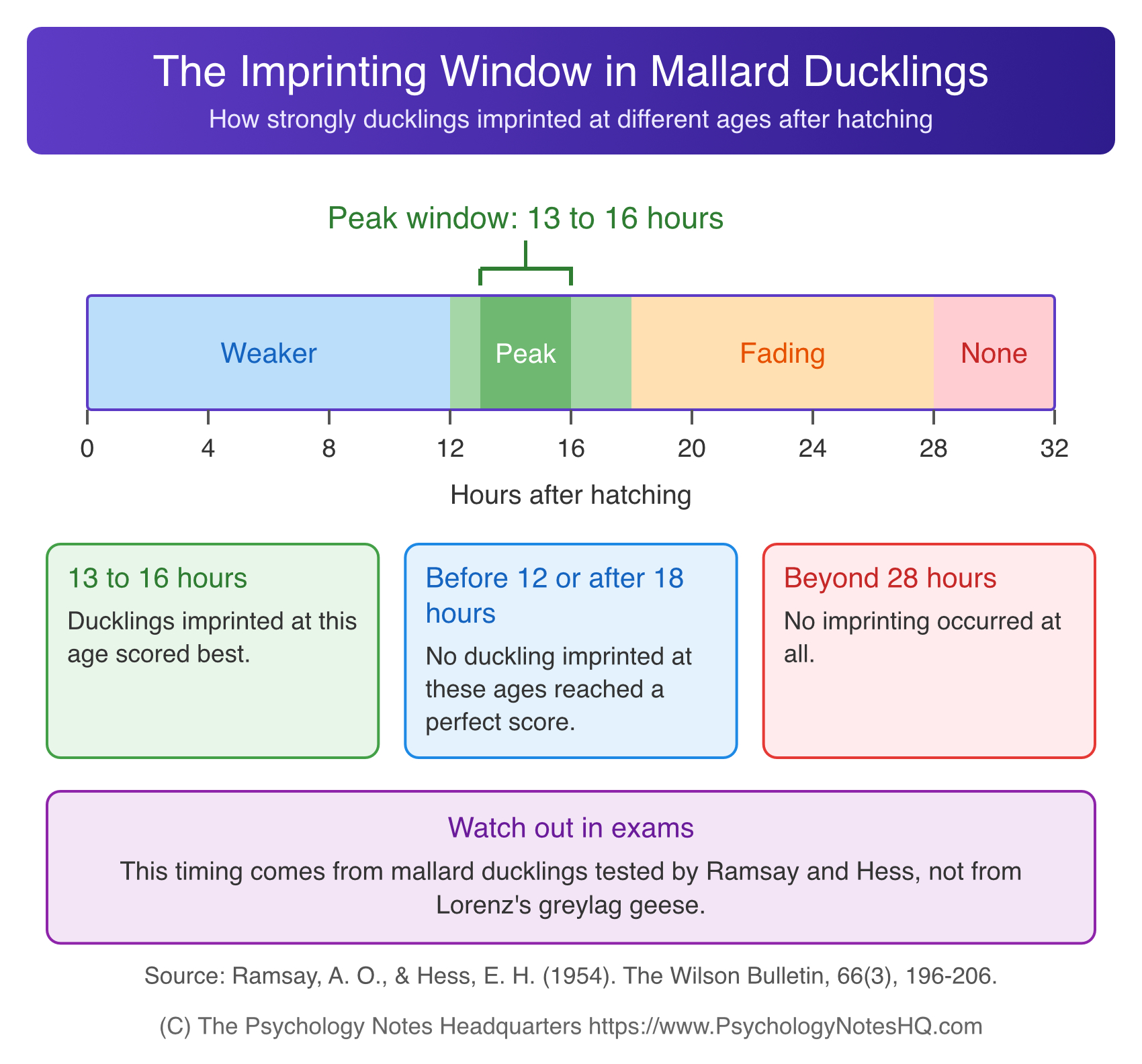
Ducklings imprinted at 13 to 16 hours after hatching scored best. None of the ducklings imprinted before 12 hours or after 18 hours achieved perfect scores, and beyond 28 hours no imprinting occurred (Ramsay & Hess, 1954).
The Effort Effect
Hess (1958) also reported that effort mattered. Ducklings that had to work harder to keep up with the moving model showed stronger imprinting.
In other words, following wasn’t just a passive reaction. The more active the duckling’s part in the process, the stronger the bond that formed.
One detail that textbooks often blur: this famous timing comes from mallard ducklings, not from Lorenz’s goslings.
Cracks in the “Critical” Idea
Guiton’s Rubber Glove Chickens
Philip Guiton studied Brown Leghorn chickens raised with yellow rubber gloves present at feeding time. The young birds imprinted on the gloves, and some males later tried to court them, which fit Lorenz’s predictions nicely (Guiton, 1966).
Then came the twist. After these males spent time living with other chickens, they mated normally with their own species. The early preference had been overridden, not locked in forever.
When the Window Stretched
Other studies showed that the window itself was flexible. Birds kept in isolation stayed ready to imprint for longer than birds raised with companions. Across species and conditions, the period usually lasts several days and varies a lot in length (McCabe, 2019).
The window also closes partly because of what the bird learns. Once a chick knows one object well, it approaches the familiar and avoids anything new, so later imprinting gets harder (McCabe, 2019).
Critical Period vs Sensitive Period: What Changed
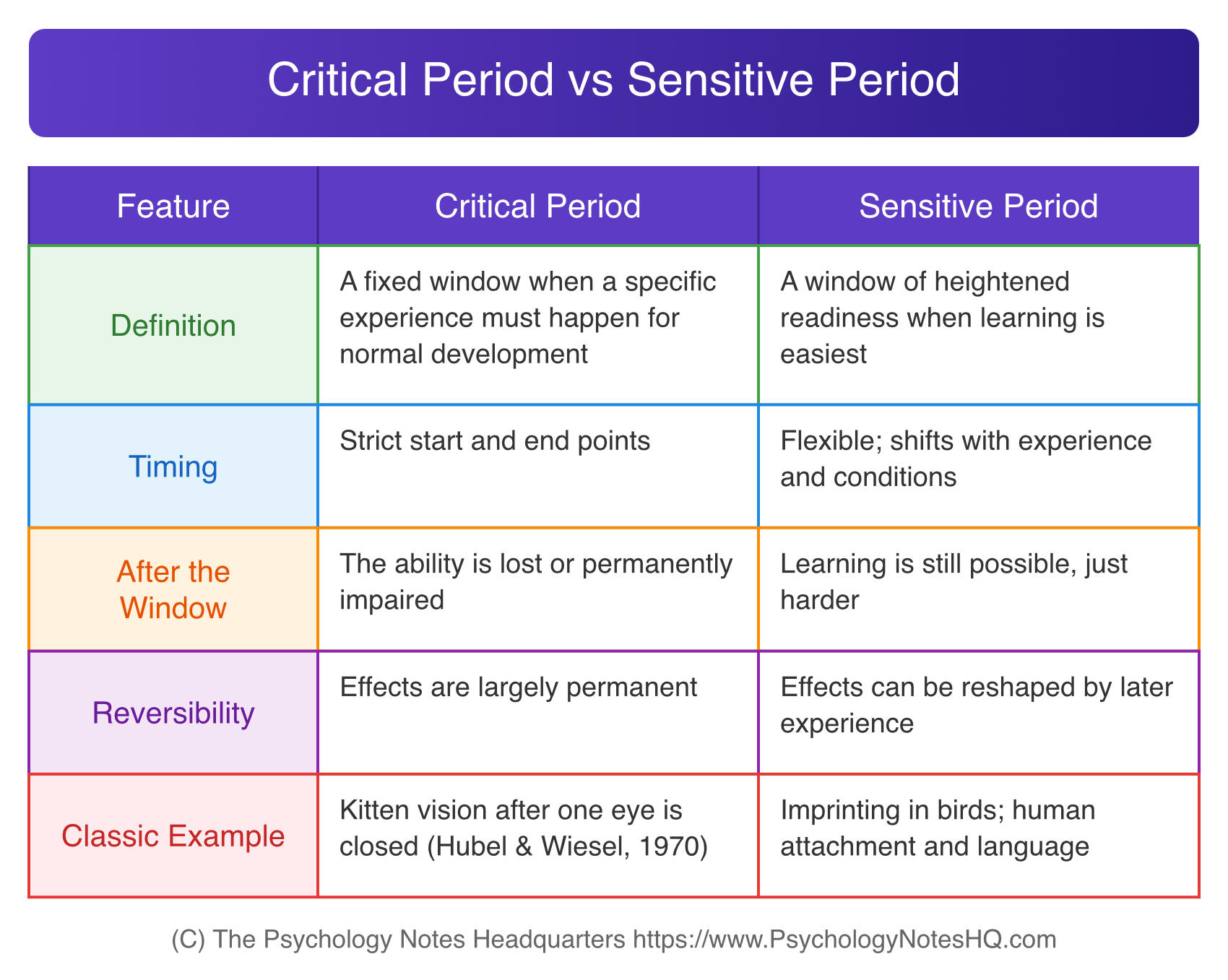
These findings forced a change in vocabulary. A critical period is a fixed window. The right experience has to happen inside it, or the ability never develops normally.
A sensitive period is a window of heightened readiness. Learning is easiest during it but still possible later, just harder.
Patrick Bateson (1979) made an influential case that “sensitive period” fit the imprinting evidence better, since the onset of the window depends on changes in the animal’s state rather than a fixed clock. Today, the critical period vs sensitive period distinction runs through psychology, from bird behavior to human language.
A Quick Way to Tell Them Apart
When you compare a critical period vs sensitive period, ask three questions. Is the timing strict or flexible? Can the outcome be changed later? What happens if the window is missed: is the ability lost, or just harder to build?
A strict window with permanent effects points to a critical period. A flexible window with later catch-up points to a sensitive period.
The Critical Period in Development: Do Humans Imprint?
Humans don’t imprint the way goslings do. Newborns can’t walk after anyone, and human bonds build over months rather than hours. Milestones like separation anxiety in infants don’t appear until well into the first year.
Still, the idea of a critical period in development shaped how psychologists studied babies, starting with attachment.
Attachment
John Bowlby borrowed directly from Lorenz’s imprinting work when he built attachment theory (Robledo et al., 2022). For humans, though, he described a sensitive window rather than a strict cutoff. Harlow’s research pushed in a similar direction, showing that baby monkeys chose soft comfort over food.
Later studies of children adopted from severely deprived Romanian orphanages found that those adopted earlier generally recovered more fully, while many later-adopted children still made real gains. That’s a sensitive period pattern, not a critical one.
Language
Language is the other classic example. In the late 1960s, linguist Eric Lenneberg proposed that first language learning has a biological window that closes around puberty.
The evidence for a hard cutoff is still debated. Children pick up a first language with remarkable ease, and people who learn a second language later often keep an accent. Yet older learners can still become highly fluent, so many researchers now describe language timing in sensitive period terms.
Critical Period Brain Development: What Hubel and Wiesel’s Kittens Showed
Some windows really are close to critical. David Hubel and Torsten Wiesel closed one eyelid in kittens at different ages. Sensitivity began suddenly near the start of the fourth week, stayed high until the sixth to eighth week, and faded out by the end of the third month (Hubel & Wiesel, 1970).
Closure during that window caused lasting changes in how the visual cortex responded to the deprived eye. In adult cats, a year of closure had no detectable effect.
This is the clearest case of critical period brain development, which is why “critical” never fully disappeared.
Even Here, Some Flexibility
Later kitten studies found that the damage wasn’t always total. When the originally open eye was covered early enough, vision through the deprived eye could improve. Brain windows can be steep, but researchers still found room for partial recovery under the right conditions.
Imprinting Outside the Textbook
Imprinting isn’t just a historical curiosity. Conservation programs have used it to help captive-raised birds survive in the wild.
In some crane projects, chicks were raised around ultralight aircraft and costumed caretakers, then followed the aircraft along migration routes they had never flown. The trick works for the same reason Lorenz’s goslings trailed him: the young bird learns to follow whatever reliable moving “parent” it meets early on.
The costumes matter too. Keeping human faces hidden helps prevent the birds from imprinting on people, which would cause trouble once they’re released.
Common Misconceptions About Konrad Lorenz’s Imprinting Work
A few myths about Konrad Lorenz’s imprinting work show up in essays year after year.
Myths About the Research
“Lorenz discovered imprinting.” Earlier naturalists, including Douglas Spalding in the 1870s and Lorenz’s mentor Oskar Heinroth, had described the following response. Lorenz named it and built theory around it.
“Lorenz found the 13 to 16 hour window.” That timing came from Ramsay and Hess’s work with mallard ducklings.
Myths About What Imprinting Does
“Human babies imprint on their mothers at birth.” They don’t. Human attachment builds gradually across the first year and beyond.
“Imprinting is always permanent.” Guiton’s chickens showed that even sexual imprinting can be reshaped by later experience.
“Animals bond with whoever feeds them.” Lorenz’s goslings followed him without being fed, and Harlow’s monkeys preferred a soft surrogate to a wire one with milk.
Evaluating Lorenz in an Exam Answer
If you’re asked to evaluate this research, balance the strengths against the limits.
Strengths
The basic effect has been replicated many times in birds. It gave Bowlby an evolutionary foundation for attachment, and it showed that early experience can have long-term effects on social behavior.
Limitations
Most findings come from precocial birds, so generalizing to human infants is risky. The original “critical” window turned out to be more flexible than claimed, and the irreversibility claim didn’t hold up well for sexual imprinting. Lorenz’s early work also relied on naturalistic observation with limited experimental control.
Putting It in Context
Comparing ethology with other early childhood development theories also earns marks, since it was the approach that brought evolution and timing into the picture. Piaget focused on how thinking changes, and Freud on inner drives. Lorenz asked a different question: why would a developing animal be built to learn certain things at certain times?
Conclusion
Lorenz’s line of goslings made a simple point that still holds: timing matters. Some experiences shape development far more when they arrive early.
What didn’t hold up was the idea of a window that slams shut forever. From Hess’s ducklings to Guiton’s chickens to Hubel and Wiesel’s kittens, the evidence points to windows that open, peak and taper, with some closing harder than others. Knowing that difference is what turns a textbook definition into a strong exam answer.
References
- Bateson, P. (1979). How do sensitive periods arise and what are they for? Animal Behaviour, 27(2), 470-486.
- Guiton, P. (1966). Early experience and sexual object-choice in the brown leghorn. Animal Behaviour, 14(4), 534-538.
- Hess, E. H. (1958). “Imprinting” in animals. Scientific American, 198(3), 81-90.
- Hubel, D. H., & Wiesel, T. N. (1970). The period of susceptibility to the physiological effects of unilateral eye closure in kittens. The Journal of Physiology, 206(2), 419-436.
- Lorenz, K. (1935). Der Kumpan in der Umwelt des Vogels: Der Artgenosse als auslösendes Moment sozialer Verhaltensweisen. Journal für Ornithologie, 83, 137-213.
- McCabe, B. J. (2019). Visual imprinting in birds: Behavior, models, and neural mechanisms. Frontiers in Physiology, 10, 658.
- Ramsay, A. O., & Hess, E. H. (1954). A laboratory approach to the study of imprinting. The Wilson Bulletin, 66(3), 196-206.
- Robledo, J.-P., Cross, I., Boada-Bayona, L., & Demogeot, N. (2022). Back to basics: A re-evaluation of the relevance of imprinting in the genesis of Bowlby’s attachment theory. Frontiers in Psychology, 13, 1033746.
How to cite this article:
The Psychology Notes Headquarters. (2026). Konrad Lorenz Imprinting: Why Goslings Followed a Scientist. Retrieved from https://www.psychologynoteshq.com/imprinting/