
Reciprocal Determinism: Why Bandura’s 3 Factors Aren’t Equal
Reciprocal determinism is Albert Bandura’s idea that a person’s thoughts and traits, their behavior, and their environment continuously influence one another, so no single factor is the sole cause of what people do.
Picture a student who doubts her math ability. She skips practice, her grades slip, her teacher starts expecting less, and her doubt deepens. Nothing in that chain runs one way.
Bandura (1978) built the model to challenge both strict behaviorism and pure trait explanations, and it later became the backbone of his social cognitive theory.
Key Takeaways
- The three factors rarely carry equal weight. Which one dominates depends on the person, the activity and the situation.
- “Determinism” here does not mean your life is fixed. Bandura meant something much narrower, and exams love to test the difference.
- Triadic reciprocal causation is the same model under a later name, so two terms in your textbook describe one idea.
- You deal with three kinds of environment, and you personally choose or build two of them.
- A test across 30 nations found the belief and performance loop in most countries, but not in all of them.
What Is Reciprocal Determinism?
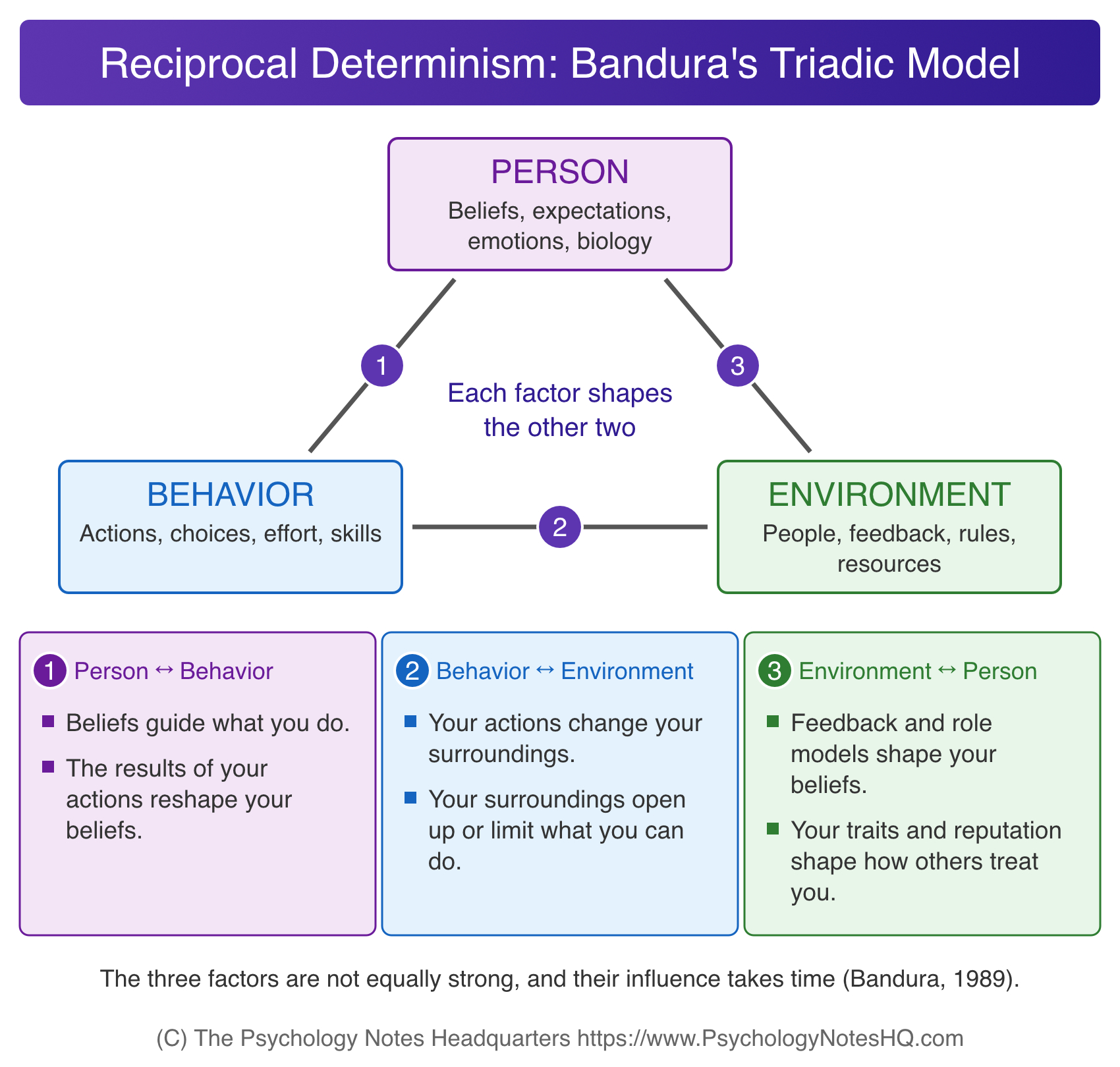
Reciprocal determinism is the causal model at the center of Albert Bandura’s work. It says that human functioning comes from a continuous three-way interaction between personal factors, behavior and the environment (Bandura, 1978).
Both words in the name matter. “Reciprocal” means influence runs in both directions between every pair of factors. Your beliefs shape what you do, and what you do reshapes your beliefs.
“Determinism” is the word that trips students up. Bandura (1978) used it simply to mean that events produce effects. He did not mean that your actions are locked in by earlier causes you have no say in. The model actually argues the opposite, because people help create the conditions that later influence them.
Before this model, psychology was stuck in a tug of war. Radical behaviorists argued that the environment controls behavior. Trait and psychodynamic theorists argued that inner dispositions drive it. Bandura thought both camps made the same mistake of treating causation as a one-way street.
The idea grew out of his social learning theory, which had already shown that people learn by watching others and thinking about what they see. The new model supplied the bigger picture of how those thoughts, actions and surroundings fit together.
The Three Factors: Person, Behavior and Environment
Students often summarize the model as “person, behavior and environment” and stop there. The details of what belongs in each corner are where exam questions usually hide.
Personal Factors
The person corner covers everything going on inside you. That includes cognitive events such as beliefs, expectations, goals and self-perceptions, along with emotions and biological characteristics (Bandura, 1999).
One personal factor gets more attention than any other: self-efficacy, your belief that you can pull off a specific task.
Personal factors also include things other people can see. Bandura (1989) pointed out that physical characteristics, social roles and reputation draw reactions from others before a person says or does anything. A child known as tough gets treated differently from a child known as timid.
Behavior
Behavior is what you actually do: the choices you make, the effort you put in, the skills you use and how long you persist.
The key move in Bandura’s model is that behavior is not just an end product. Every action produces results, and those results feed back into your beliefs and into your surroundings.
Environment
The environment covers your physical surroundings and your social world: other people, the feedback they give, the models you observe, the rules you live under and the resources within reach.
Here is a detail many summaries skip. Most environmental influences sit idle until behavior switches them on. Bandura (1989) noted that a lecturer influences only the students who show up to class, and a hot stove burns only the person who touches it.
How the Three Factors Influence Each Other
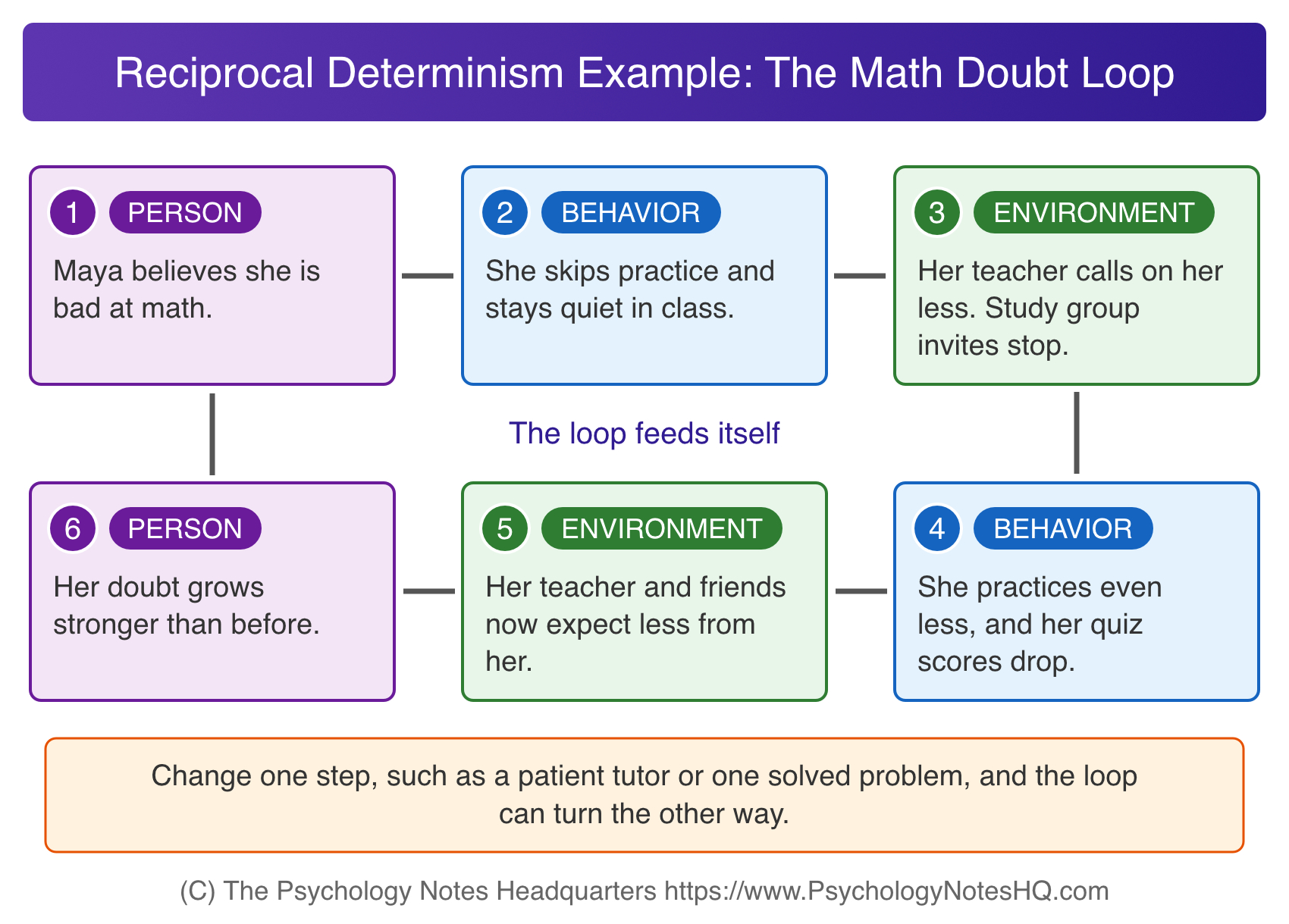
Three factors with two-way links give six directions of influence. Go back to the student from the introduction, and call her Maya.
Person to behavior. Maya believes she is bad at math, so she skips practice problems and stays quiet in class.
Behavior to environment. Because she never volunteers, her teacher calls on her less. Classmates stop inviting her to their study group.
Environment to behavior. With no study group and fewer chances to try problems aloud, she practices even less, and her quiz scores drop.
Behavior to person. Each low score looks like proof. Her doubt hardens into “I’m just not a math person.”
Environment to person. Her teacher’s lowered expectations and a friend’s offhand “some people just can’t do math” persuade her further.
Person to environment. Her visible anxiety and her reputation now shape how people treat her, even on days when she does nothing differently.
Left alone, a loop like this can start to resemble learned helplessness. The hopeful part is that the same structure works in reverse. One patient tutor, one solved problem or one small shift in belief can start the loop turning the other way.
Why the Three Factors Are Not Equal
Textbook diagrams draw a tidy triangle with three identical arrows. That picture leads many students to assume each factor contributes one third. Bandura said no such thing.
He was explicit that the different sources of influence are not of equal strength, and that their relative weight changes across people, activities and circumstances (Bandura, 1989).
Sometimes the environment overpowers everything else. When a fire alarm goes off in a lecture hall, everyone walks out, whatever their personality or beliefs.
Sometimes the person dominates. On a free Saturday with no obligations, what you do depends almost entirely on your own preferences and goals.
Timing matters too. The influences do not all fire at the same instant. It takes time for one factor to have its effect and to set off the return influence (Bandura, 1983, 1989). Maya’s doubt did not lower her grade in a single afternoon.
That time lag is useful for researchers. It means they can study one segment of the loop at a time, such as how beliefs affect later performance, without having to measure everything at once.
Reciprocal Determinism Examples in Everyday Life
The best reciprocal determinism examples are the ones where you can label each step as person (P), behavior (B) or environment (E). Try it with these four.
The first-year student who expects rejection. He assumes people will not like him (P), so he skips residence events and gives one-word answers (B). Invitations dry up (E), which confirms what he expected all along (P).
The streaming feed. Bandura (1978) used television to make this point: viewers’ preferences shape what they watch, and what gets watched shapes what networks offer next. Today the loop is faster. Your tastes (P) guide what you click (B), the algorithm serves more of the same (E), and your tastes narrow (P).
The running habit. A student thinks she can probably manage a 5K (P), so she joins a campus running club (B). Now a group expects her every Saturday and cheers her progress (E). Her confidence grows (P), and she signs up for a 10K (B).
The child who expects hostility. A boy assumes other kids are out to get him (P), so he shoves first (B). Peers retaliate or avoid him (E), and his belief looks correct (P). Bandura (1989) observed that aggressive people tend to produce hostile environments wherever they go, while friendlier people tend to generate a warmer social climate.
Notice that two of these loops spiral down and one spirals up. The model itself is neutral. It describes how change spreads, not which direction it goes.
Triadic Reciprocal Causation: Why Bandura Changed the Name
If your textbook says reciprocal determinism and your professor says triadic reciprocal causation, they are talking about the same model.
Bandura introduced the original term in the late 1970s, when his framework was still called social learning theory (Bandura, 1978). In his 1986 book, Social Foundations of Thought and Action, he renamed the whole framework social cognitive theory and stressed that the model has three interacting parts.
For a while he wrote of “triadic reciprocal determinism” (Bandura, 1989). In his later papers, triadic reciprocal causation became the standard label (Bandura, 1999).
The newer name has two practical advantages. “Triadic” makes it clear there are three factors, not just a person and a situation. And dropping “determinism” removes the word most likely to be misread as fatalism.
For exams, treat the terms as interchangeable. Introductory textbooks usually stick with Bandura’s reciprocal determinism, while upper-level courses and his later writing prefer the newer label.
Three Types of Environment: Imposed, Selected and Constructed
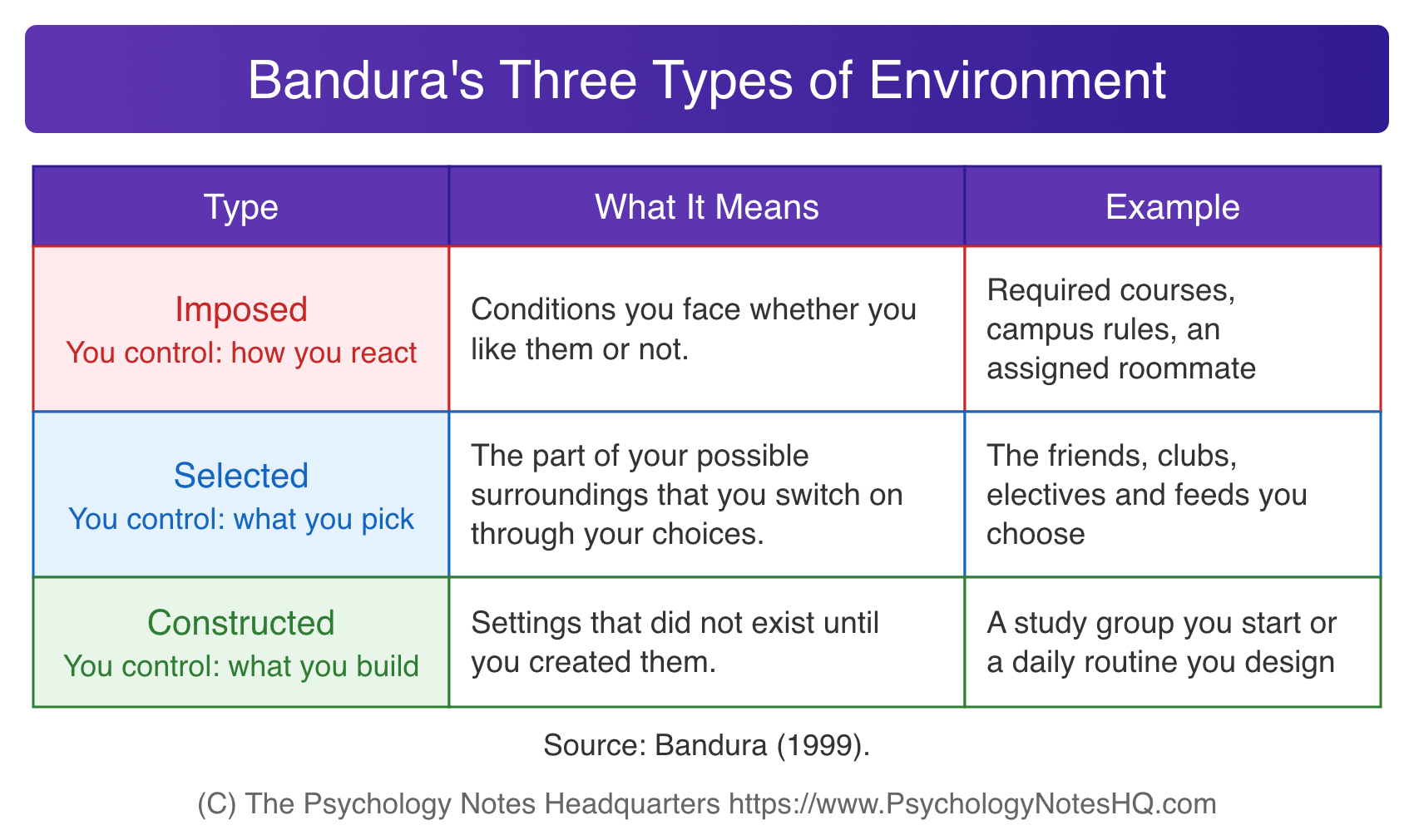
One of Bandura’s most useful later refinements is that “the environment” is not one single thing. He described three kinds, sorted by how much say you have over them (Bandura, 1999).
The imposed environment is the set of conditions you face whether you like it or not, such as required courses or campus rules. Even here you keep some freedom in how you interpret and react to them.
The selected environment is the part of your potential surroundings that you actually activate. The same campus offers hundreds of clubs, friends and electives. Only the ones you pick become your real environment.
The constructed environment did not exist until you built it. Starting a study group or designing a daily routine creates a setting that then influences you.
This is a different way of thinking from Bronfenbrenner’s ecological systems theory, which sorts environments by how close they sit to the person. Bandura sorts them by how much control you have.
Chance has a place here as well. Bandura (1999) acknowledged that fortuitous events, like an unplanned meeting, can launch entirely new loops of influence.
How Bandura’s Model Differs From Behaviorism and Lewin
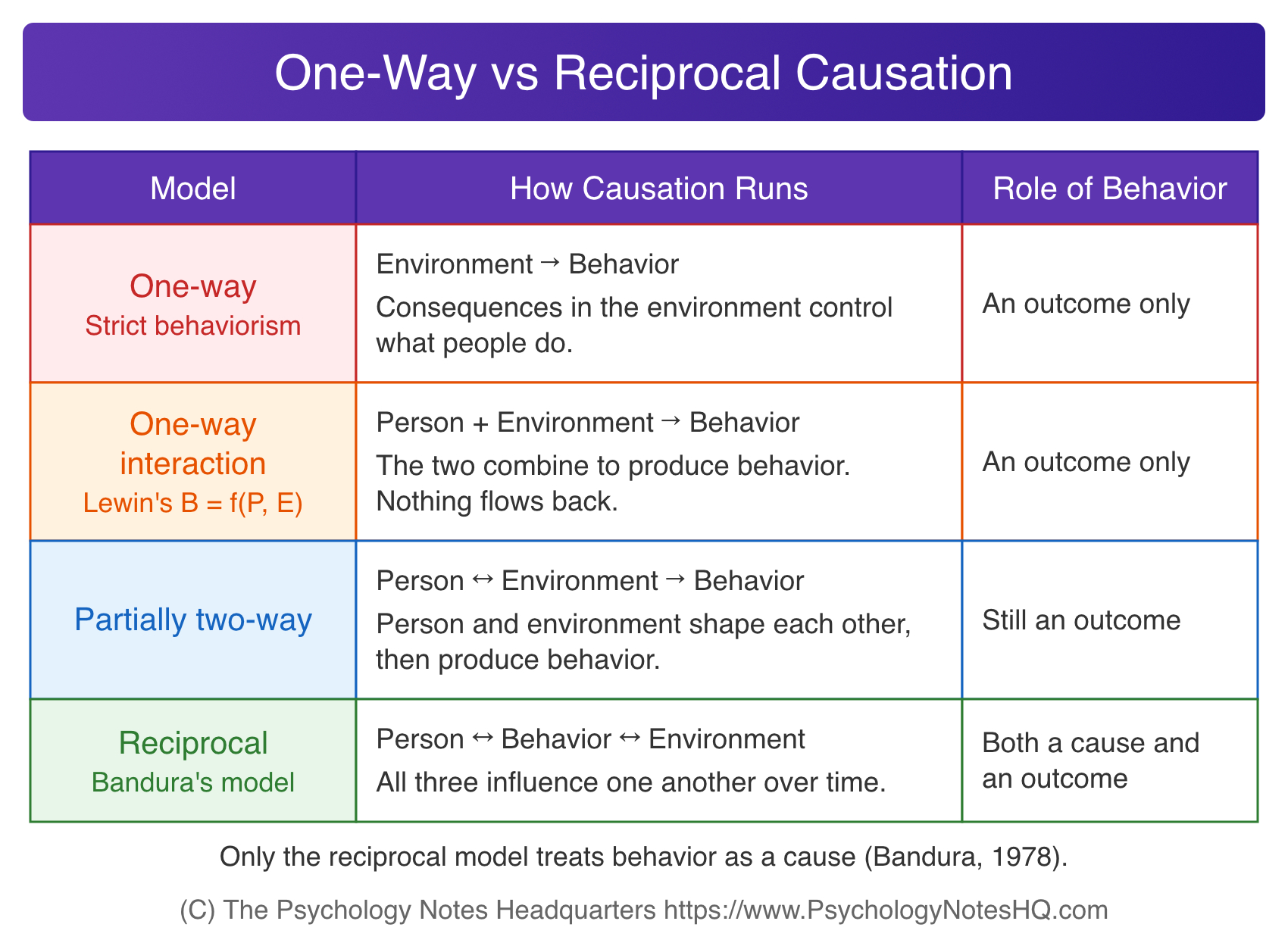
Bandura (1978) laid out the alternatives he was arguing against, and comparing them is the fastest way to see what makes his model distinct.
In strict behaviorism, causation runs one way. The environment, through reinforcement and punishment, shapes behavior. This is the logic behind operant conditioning, and it leaves little room for beliefs.
A second view lets both the person and the environment count. Kurt Lewin’s equation, B = f(P, E), is the best known version. It was a major step forward, but behavior is still only the output. Nothing flows back from behavior to the person or the situation.
A third view, which Bandura called partially bidirectional, admits that the person and the environment influence each other. Behavior remains a by-product of their interaction.
Bandura’s reciprocal determinism goes one step further. Behavior becomes a full member of the system. What you do changes your surroundings and changes you, which is why the model is drawn as a triangle and not as an equation with behavior alone on one side.
What the Research Says
Feedback loops are hard to catch in data, so direct tests of the model are rarer than you might expect.
One of the best known used mathematics data from 15-year-olds in 33 nations who took part in PISA 2003. Williams and Williams (2010) modeled math self-efficacy and math performance as a loop in which each influences the other. The model fit the data well in 30 nations, and 24 of those showed support for mutual influence.
That is strong backing, though clearly not universal.
Longitudinal work adds nuance. Sakellariou (2022) followed US high school students over time and found solid reciprocal effects for boys, with the stronger path running from earlier achievement to later confidence. For girls, the evidence of a loop was weak.
Two lessons follow. First, the loop is real, but its strength varies between groups, just as Bandura’s “not equal” caveat would predict.
Second, working out which way influence flows takes careful design. A single correlation between confidence and grades cannot show which came first, the classic correlation versus causation problem.
Criticisms and Limits
The model has drawn serious criticism, and you should be able to discuss it in an essay.
Phillips and Orton (1983) argued that ordinary one-way causal accounts could explain the very cases Bandura cited. They also called the term misleading when what is really being described is people and environments interacting.
Bandura (1983) replied that reciprocal does not mean simultaneous. The influences unfold over time, so the loop can be broken into segments and each segment tested on its own.
Other limits are practical:
- The model is flexible to the point of vagueness. It does not say in advance which factor will dominate in a given situation, which makes it hard to prove wrong.
- The full triad is rarely tested in one study. Most research examines a single pair, usually beliefs and performance.
- The cross-national results suggest culture may affect how strongly the loop operates.
Common Exam Mistakes
A few errors show up again and again in student answers.
- Reading “determinism” as fatalism. The model says people partly create their own circumstances.
- Describing only two factors. “People and environments affect each other” earns partial credit at best. Behavior is the third, separate factor.
- Assuming equal weight. The factors vary in strength from one situation to the next.
- Confusing it with observational learning. Modeling is one way the environment influences the person. It is a single arrow, not the whole triangle.
- Giving a one-way example. When you practice with reciprocal determinism examples, check that your story loops back to where it started.
Conclusion
Bandura’s model replaces the question “is it the person or the situation?” with a better one: how are the person, their behavior and their surroundings shaping each other right now?
The factors are not equal, the influences take time, and you choose or build much of the environment that acts on you. That is why the model remains so practical. To change the loop, you can start at any corner.
References
- Bandura, A. (1978). The self system in reciprocal determinism. American Psychologist, 33(4), 344-358.
- Bandura, A. (1983). Temporal dynamics and decomposition of reciprocal determinism: A reply to Phillips and Orton. Psychological Review, 90(2), 166-170.
- Bandura, A. (1986). Social foundations of thought and action: A social cognitive theory. Prentice-Hall.
- Bandura, A. (1989). Social cognitive theory. In R. Vasta (Ed.), Annals of child development: Vol. 6. Six theories of child development (pp. 1-60). JAI Press.
- Bandura, A. (1999). Social cognitive theory: An agentic perspective. Asian Journal of Social Psychology, 2(1), 21-41.
- Phillips, D. C., & Orton, R. (1983). The new causal principle of cognitive learning theory: Perspectives on Bandura’s “reciprocal determinism”. Psychological Review, 90(2), 158-165.
- Sakellariou, C. (2022). The reciprocal relationship between mathematics self-efficacy and mathematics performance in US high school students: Instrumental variables estimates and gender differences. Frontiers in Psychology, 13, Article 941253.
- Williams, T., & Williams, K. (2010). Self-efficacy and performance in mathematics: Reciprocal determinism in 33 nations. Journal of Educational Psychology, 102(2), 453-466.
How to cite this article:
The Psychology Notes Headquarters. (2026). Reciprocal Determinism: Why Bandura’s 3 Factors Aren’t Equal. Retrieved from https://www.psychologynoteshq.com/reciprocal-determinism/